
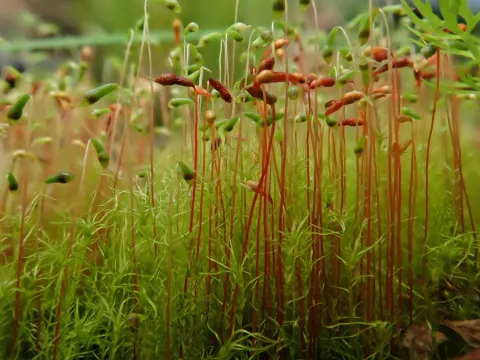
Leptobryum pear moss
Leptobryum
Leptobryum pyriforme, commonly known as pear moss, is a widespread species of moss belonging to the Bryaceae family. It is recognized for its cosmopolitan distribution and its unique ability to colonize diverse environments, ranging from disturbed urban soils to greenhouse substrates. Its biology is adapted to exploit niches where competition from higher plants is minimal.
What the section contains

Leptobryum pear moss
The plant thrives in moist, well-lit environments and is frequently encountered by horticulturists in greenhouse settings. While it is not an agricultural crop in the traditional sense, it is often studied due to its impact on pot cultures and nurseries. It exhibits a rapid growth rate, allowing it to cover large areas of soil surface in a very short time.
Botanically, it forms loose, light-green tufts with very fine, bristle-like leaves. The name 'pear moss' comes from its distinctive, pear-shaped capsules that appear on long stalks. This structure is highly efficient for spore dispersal, enabling the species to spread rapidly throughout artificial environments like potting benches and seed trays.
Requirements for its growth include a stable supply of moisture and moderate nutrient availability, particularly nitrogen. Unlike many other mosses, it can tolerate slightly varied pH levels, though it prefers neutral to slightly acidic conditions. In professional nurseries, its appearance is often considered a sign of excessive moisture and poor drainage.
Management in agricultural and horticultural practice focuses on environmental manipulation rather than chemical control. Reducing air humidity, improving ventilation, and implementing proper irrigation scheduling are the most effective ways to inhibit the growth of this moss. Proper soil drainage remains the key factor in controlling its prevalence in greenhouse production.
While Leptobryum itself is not parasitic, it acts as a secondary threat by retaining excessive moisture on the soil surface, which creates ideal conditions for root rot and other fungal pathogens. Furthermore, it creates a physical barrier that restricts oxygen exchange for the roots of horticultural seedlings, often leading to reduced growth rates in nursery stock.