
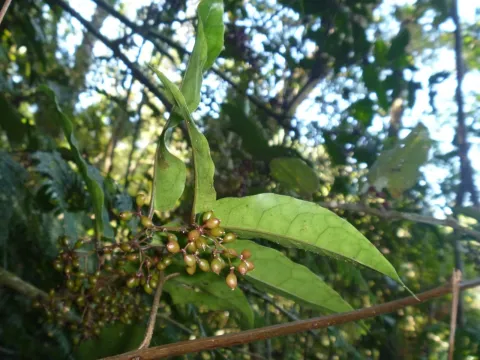
Amborella
Amborella
Amborella (Amborella trichopoda) is a unique, primitive shrub that constitutes the sole member of the family Amborellaceae. Recognized as the earliest diverging lineage among existing flowering plants (angiosperms), it serves as a critical model for understanding the evolutionary history of all modern flora.
What the section contains

Amborella
The plant is endemic to the island of New Caledonia in the South Pacific. It is found exclusively in moist, shady understories of tropical mountain forests, where it thrives in a stable, high-humidity microclimate shielded from direct solar radiation by larger canopy trees.
Cultivation requirements for Amborella are highly specialized and restrictive. It necessitates well-drained, acidic soil rich in organic matter and requires a consistent environment with high ambient moisture. Due to these specific ecological demands, it is not grown for commercial agricultural production.
From a botanical standpoint, Amborella exhibits several ancestral traits, including the absence of vessel elements in its xylem, relying instead on tracheids for water conduction. It is dioecious, meaning individual plants produce either male or female flowers, which are characterized by their simple, spiral arrangement.
Because of its limited distribution and lack of utility in food or fiber production, Amborella holds no status as a commercial crop. Its value is strictly scientific; it provides essential genomic data for research into plant evolution, phylogeny, and the development of reproductive strategies in early flowering plants.