
Woolly nightshade
Solanum mauritianum Scop.
Description
Growing requirements
Woolly nightshade (Solanum mauritianum) is a perennial shrub or small tree belonging to the Solanaceae family. It is recognized globally as a significant invasive species due to its rapid growth rate and ability to outcompete native vegetation.
Originating from South America, the plant has successfully naturalized in various subtropical and tropical regions. It thrives in disturbed habitats, roadsides, and agricultural margins where it can easily establish dense thickets.
The species requires a climate with high humidity and moderate temperatures to maintain its year-round growth cycle. It is highly adaptable to various soil types, though it performs best in moist, fertile soils with high organic matter content.
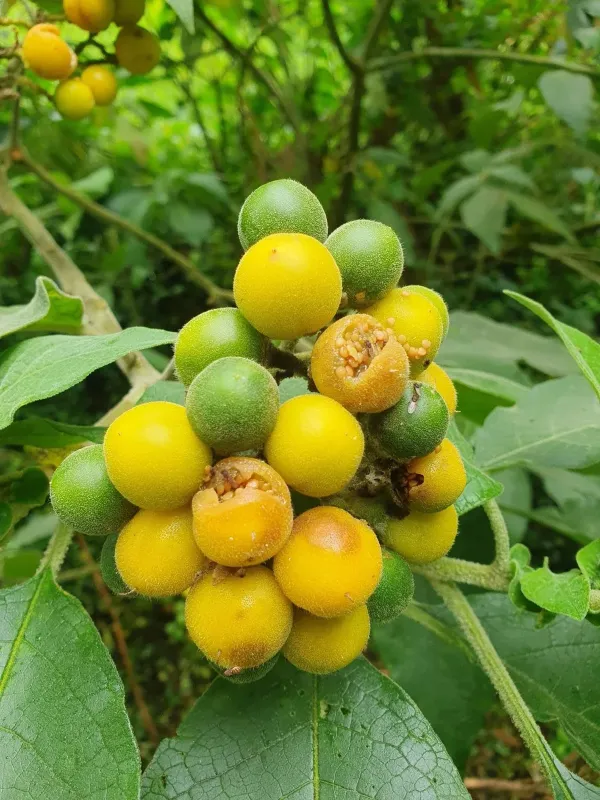
Botanically, it is distinguished by large, elliptical leaves covered in fine, felt-like hairs, which give the plant a greyish-green appearance. The flowers are typically violet with a yellow center, followed by spherical berries that turn yellow upon ripening.
From an agricultural standpoint, woolly nightshade is generally viewed as a weed. It lacks significant commercial value, and its potential toxicity poses risks to livestock, necessitating strict management in farming zones.
Main diseases and pests
Pests that affect woolly nightshade include various sap-sucking insects and leaf-miners that can cause significant foliage damage under favorable environmental conditions.
Common fungal pathogens, such as those causing leaf spots or powdery mildew, can impact the vigor of the plant, especially when growing in overcrowded conditions with low airflow.
The plant acts as a biological reservoir for various viruses and pathogens that can jump to economically important crops, including potatoes and tomatoes, making it a priority for containment.
Mechanical control, such as cutting and uprooting, is effective for small populations, while larger infestations may require systemic herbicide treatments applied to the stumps.
Integrated weed management remains the most effective strategy, combining physical removal, chemical application, and biological monitoring to ensure the long-term suppression of this invasive plant.