
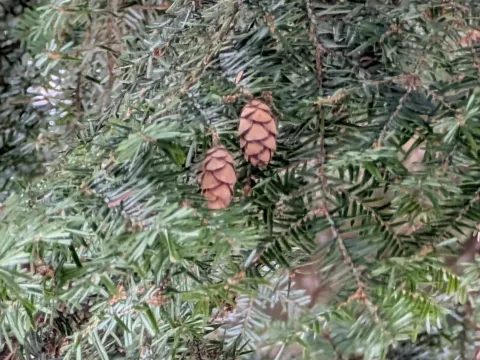
Hemlock
Tsuga
Hemlock (Tsuga) represents a genus of coniferous trees in the pine family (Pinaceae). These trees are native to temperate regions of North America and East Asia, known for their elegant, drooping foliage.
What the section contains


Hemlock
The culture thrives in cool, moist environments and requires partial shade for optimal health. Direct sunlight in hot climates often leads to foliage burn and severe dehydration of the root system.
Soil requirements focus on moisture-retentive, well-drained, acidic, and fertile substrates. Hemlock performs poorly in compacted or alkaline soils, which often leads to nutrient deficiencies.
Routine maintenance includes mulching to maintain soil moisture levels and installing irrigation systems for young specimens. They are generally sensitive to wind exposure and require protection in open areas.
The botanical structure of the tree allows for regular pruning, which is frequently used to manage size and density in professional landscaping and forest management settings.
The hemlock woolly adelgid is the most devastating pest affecting this genus, causing significant decline and tree mortality if left unchecked by integrated pest management.
Fungal diseases, such as root rot caused by Phytophthora species, are common when the drainage is insufficient or when the planting depth is not accurately managed.
Management strategies involve the application of systemic insecticides for adelgid control and strict horticultural practices to prevent the spread of soil-borne pathogens.
Monitoring for discoloration or premature needle drop is essential for timely intervention with appropriate fungicide or insecticide treatments during the growing season.
Providing optimal site conditions remains the most effective form of preventative care, as healthy trees exhibit much stronger natural resistance to recurring infestations.