
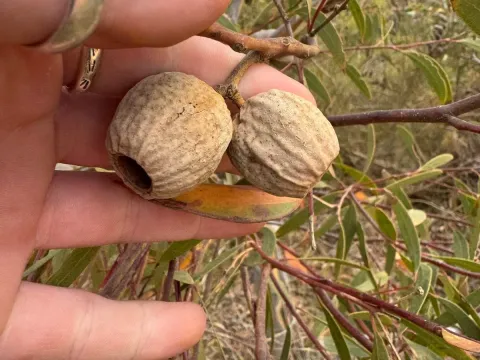
Eucalyptus
Eucalyptus
Eucalyptus (Eucalyptus) is a prominent genus of flowering trees in the Myrtaceae family. Native to Australia and surrounding islands, these trees have been introduced globally for their rapid growth and economic value.
What the section contains
 Archer's Eucalyptus
Eucalyptus archeri
Archer's Eucalyptus
Eucalyptus archeri
 Argyle apple (Eucalyptus argophloia)
Eucalyptus argophloia
Argyle apple (Eucalyptus argophloia)
Eucalyptus argophloia
 Bailey's Stringybark
Eucalyptus baileyana
Bailey's Stringybark
Eucalyptus baileyana
 Black box
Eucalyptus bicolor
Black box
Eucalyptus bicolor
 Black Gum
Eucalyptus aggregata
Black Gum
Eucalyptus aggregata
 Blakely's red gum
Eucalyptus blakelyi
Blakely's red gum
Eucalyptus blakelyi
 Blue Mountains Ash
Eucalyptus oreades
Blue Mountains Ash
Eucalyptus oreades
 Blue-leaved stringybark
Eucalyptus agglomerata
Blue-leaved stringybark
Eucalyptus agglomerata
 Brooker's Gum
Eucalyptus brookeriana
Brooker's Gum
Eucalyptus brookeriana
 Brown stringybark
Eucalyptus baxteri
Brown stringybark
Eucalyptus baxteri
 Bullich
Eucalyptus megacarpa
Bullich
Eucalyptus megacarpa
 Bundy
Eucalyptus goniocalyx
Bundy
Eucalyptus goniocalyx
 Burgess's Eucalyptus
Eucalyptus burgessiana
Burgess's Eucalyptus
Eucalyptus burgessiana
 Camfield's Stringybark
Eucalyptus camfieldii
Camfield's Stringybark
Eucalyptus camfieldii
 Coolabah
Eucalyptus coolabah
Coolabah
Eucalyptus coolabah
 Coral gum
Eucalyptus torquata
Coral gum
Eucalyptus torquata
 Cunningham's eucalyptus
Eucalyptus cunninghamii
Cunningham's eucalyptus
Eucalyptus cunninghamii
 Darwin woollybutt
Eucalyptus tetrodonta
Darwin woollybutt
Eucalyptus tetrodonta
 Deua Eucalyptus
Eucalyptus deuaensis
Deua Eucalyptus
Eucalyptus deuaensis
 Eucalyptus acaciiformis
Eucalyptus acaciiformis
Eucalyptus acaciiformis
 Eucalyptus acies
Eucalyptus acies
Eucalyptus acies
 Eucalyptus albida
Eucalyptus albida
Eucalyptus albida
 Eucalyptus amygdalina
Eucalyptus amygdalina
Eucalyptus amygdalina
 Eucalyptus andrewsii
Eucalyptus andrewsii
Eucalyptus andrewsii
 Eucalyptus apiculata
Eucalyptus apiculata
Eucalyptus apiculata
 Eucalyptus barberi
Eucalyptus barberi
Eucalyptus barberi
 Eucalyptus baueriana
Eucalyptus baueriana
Eucalyptus baueriana
 Eucalyptus bicostata
Eucalyptus bicostata
Eucalyptus bicostata
 Eucalyptus bosistoana
Eucalyptus brassiana
Eucalyptus brassiana
Eucalyptus bosistoana
Eucalyptus bosistoana
Eucalyptus brassiana
Eucalyptus brassiana
 Eucalyptus brockwayi
Eucalyptus brockwayi
Eucalyptus brockwayi
 Eucalyptus cambageana
Eucalyptus cambageana
Eucalyptus cambageana
 Eucalyptus campanulata
Eucalyptus campanulata
Eucalyptus campanulata
 Eucalyptus camphora
Eucalyptus camphora
Eucalyptus camphora
 Eucalyptus carnea
Eucalyptus carnea
Eucalyptus carnea
 Eucalyptus castrensis
Eucalyptus castrensis
Eucalyptus castrensis
 Eucalyptus cephalocarpa
Eucalyptus cephalocarpa
Eucalyptus cephalocarpa
 Eucalyptus cneorifolia
Eucalyptus cneorifolia
Eucalyptus cneorifolia
 Eucalyptus coccifera
Eucalyptus coccifera
Eucalyptus coccifera
 Eucalyptus consideniana
Eucalyptus consideniana
Eucalyptus consideniana
 Eucalyptus conspicua
Eucalyptus conspicua
Eucalyptus conspicua
 Eucalyptus copulans
Eucalyptus copulans
Eucalyptus copulans
 Eucalyptus cordata
Eucalyptus cordata
Eucalyptus cordata
 Eucalyptus cornuta
Eucalyptus cornuta
Eucalyptus cornuta
 Eucalyptus crebra
Eucalyptus crebra
Eucalyptus crebra
 Eucalyptus crenulata
Eucalyptus crenulata
Eucalyptus crenulata
 Eucalyptus curtisii
Eucalyptus curtisii
Eucalyptus curtisii
 Eucalyptus deflexa
Eucalyptus deflexa
Eucalyptus deflexa
 Eucalyptus dendromorpha
Eucalyptus dendromorpha
Eucalyptus dendromorpha
 Eucalyptus denticulata
Eucalyptus denticulata
Eucalyptus denticulata
 Eucalyptus dichromophloia
Eucalyptus dichromophloia
Eucalyptus dichromophloia
 Eucalyptus dives
Eucalyptus dives
Eucalyptus dives
 Eucalyptus drepanophylla
Eucalyptus drepanophylla
Eucalyptus drepanophylla
 Eucalyptus dumosa
Eucalyptus dumosa
Eucalyptus dumosa
 Eucalyptus eugenioides
Eucalyptus eugenioides
Eucalyptus eugenioides
 Eucalyptus exserta
Eucalyptus exserta
Eucalyptus exserta
 Eucalyptus foecunda
Eucalyptus foecunda
Eucalyptus foecunda
 Eucalyptus froggattii
Eucalyptus froggattii
Eucalyptus froggattii
 Eucalyptus gillii
Eucalyptus gillii
Eucalyptus gillii
 Eucalyptus gracilis
Eucalyptus gracilis
Eucalyptus gracilis
Eucalyptus
The culture requires a warm, frost-free climate to thrive. It is highly sensitive to extreme cold, which can cause severe dieback or total mortality in young plantations.
Well-drained soils are essential for Eucalyptus health. While it can tolerate a variety of soil types, it struggles in waterlogged conditions where root respiration is restricted.
High solar irradiance is a key requirement for maximizing the photosynthesis rate, which in turn fuels the tree's rapid biomass accumulation cycle.
Proper field preparation, including deep plowing and amendment of nutrient-poor soils, is standard practice to ensure uniform seedling establishment across the plantation.
Eucalyptus plantations are susceptible to various defoliating insects, such as Gonipterus weevils, which can significantly reduce the photosynthetic capacity of the trees.
Fungal diseases, including leaf spots and root rots caused by Phytophthora and Cylindrocladium, pose a major risk, especially in humid and stagnant air conditions.
Bacterial wilt remains a critical issue in certain regions, often transmitted through contaminated nursery stock or soil movement between fields.
Integrated pest management strategies are vital, focusing on resistant cultivars, biological controls, and monitoring programs to detect outbreaks early.
Environmental stress, such as prolonged drought or nutrient imbalance, can weaken trees, making them significantly more vulnerable to pathogen attacks and pest colonization.
Commercial harvesting cycles for pulpwood production are typically short, often ranging from 7 to 12 years, depending on the specific species and management goals.
Leaf harvesting for essential oil extraction involves selective pruning of branches, ensuring the tree structure remains intact for future regenerative growth.
The ability of Eucalyptus to sprout from the stump, known as coppicing, allows for multiple harvests from a single planting, significantly improving the economic efficiency of the crop.
Mechanized felling and harvesting equipment is generally employed to maximize yield per hectare and reduce manual labor costs in large-scale operations.
Post-harvest management involves clearing debris to mitigate fire risks and disease spread, as well as thinning new sprouts to promote the development of the most vigorous stems.