
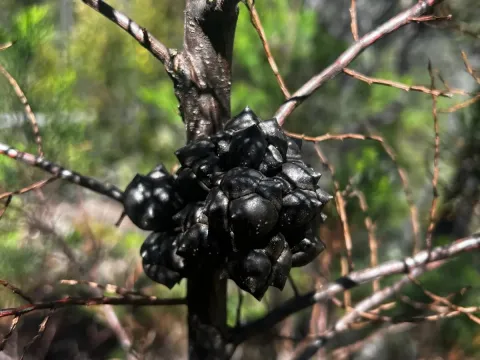
Callitris
Callitris Vent.
Propagation of Callitris is primarily achieved through seeds, which should be sown in early spring to allow for a full growing season. The seeds require a well-draining, sandy-based medium to prevent damping-off, a common issue with young coniferous seedlings.
What the section contains

Callitris
In nursery settings, it is essential to ensure that seeds are only lightly covered with substrate. Light is often a beneficial factor for the germination of many Callitris species, reflecting their natural ecological adaptation to post-fire recovery.
Container cultivation is highly recommended, as it allows for the development of a robust root system before field planting. This approach significantly increases the survival rate of young plants in arid or semi-arid conditions.
Hardening off the seedlings is a critical step in the propagation process. Gradually exposing the young plants to outdoor conditions over several weeks helps them adapt to temperature fluctuations and increased light intensity.
Spacing at the time of sowing depends on the ultimate purpose of the stand. For timber production, higher density is preferred, whereas landscape plantings require more space to allow for the development of the natural crown shape.
Callitris is a genus of coniferous trees and shrubs belonging to the Cupressaceae family, naturally occurring across Australia. These plants are exceptionally well-adapted to hot, dry climates and thrive in full sun exposure.
Regarding soil preferences, Callitris is not particularly demanding, but it strictly requires excellent drainage. It performs best in sandy, gravelly, or rocky soils, while heavy clay soils that retain water are detrimental to its health.
The plant demonstrates remarkable drought tolerance once established. Its needle-like leaves and specific physiological mechanisms minimize transpiration, allowing it to survive in regions with significant water deficits.
Nutrient requirements are relatively low. Over-fertilization, especially with nitrogen-heavy products, should be avoided as it can promote succulent growth that is prone to pests and physical damage.
Pruning is mostly limited to removing dead branches or correcting the shape of young trees. Maintaining airflow through the canopy is beneficial for long-term health and prevents the buildup of humidity within the foliage.
The economic value of Callitris is largely derived from its high-quality timber. The wood is renowned for its density, aromatic properties, and extraordinary resistance to decay and termite infestation.
This timber is widely utilized in the manufacturing of fine furniture, flooring, and decorative interior panels. The slow growth rate of the tree contributes to the superior hardness and longevity of the final wood products.
Beyond timber, various species of Callitris are processed to extract essential oils from their foliage and resin. These oils are used in perfumery and pharmaceutical industries for their antiseptic and therapeutic benefits.
In environmental management, Callitris serves as a vital component in erosion control and land rehabilitation projects. Its ability to colonize degraded soils makes it a powerful tool for forest restoration.
In urban landscaping, Callitris provides aesthetic value as a low-maintenance, evergreen feature. Its ability to retain shape and color in extreme heat makes it a top choice for xeriscaping in arid climates.
Callitris species are naturally resistant to many pests due to the presence of resinous compounds in their tissues. However, they are susceptible to root pathogens if the soil remains waterlogged for extended periods.
Young plants are most vulnerable to competition from weeds. Keeping the area around the base of the plant clear of competing vegetation is essential during the first two to three years of growth.
While mature trees are rarely affected by insects, outbreaks of needle-eating larvae can occur under specific environmental stress. Monitoring the density of the foliage is a key practice for early detection of such issues.
Fire represents the most significant threat to Callitris stands. Although some species are adapted to survive periodic fires, intense or frequent blazes can be devastating, requiring active fire prevention strategies in commercial plantations.
Mechanical damage from agricultural machinery can introduce pathogens into the tree trunk. Careful management and precise operation of equipment are necessary to preserve the integrity of the bark and vascular system.