
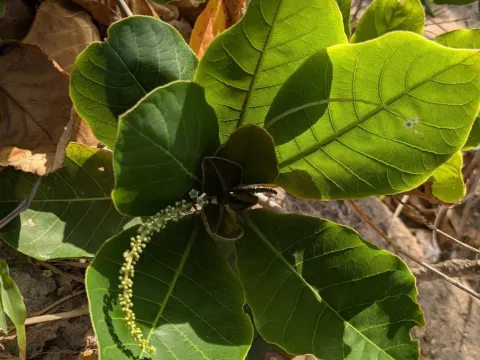
Terminalia
Terminalia
Terminalia is a genus of large-growing trees of the Combretaceae family, comprising over 200 species. These are primarily deciduous trees of tropical and subtropical zones, widely distributed across Africa, Asia, and Australia.
What the section contains
 Amazonian terminalia
Terminalia amazonia (J. F. Gmel.) Exell
Amazonian terminalia
Terminalia amazonia (J. F. Gmel.) Exell
 Madagascar almond
Terminalia mantaly H. Perrier
Madagascar almond
Terminalia mantaly H. Perrier
 Terminalia arjuna
 (Roxb. ex DC.) Wight & Arn.
Terminalia arjuna
Terminalia arjuna (Roxb. ex DC.) Wight & Arn.
 Terminalia catappa
 L.
Terminalia catappa
Terminalia catappa L.
 Terminalia ivorensis
 A. Chev.
Terminalia ivorensis
Terminalia ivorensis A. Chev.
 Terminalia latipes
 Benth.
Terminalia latipes psilocarpa
Terminalia latipes Benth. subsp. psilocarpa Pedley
Terminalia neotaliala
Terminalia neotaliala Capuron
Terminalia latipes
Terminalia latipes Benth.
Terminalia latipes psilocarpa
Terminalia latipes Benth. subsp. psilocarpa Pedley
Terminalia neotaliala
Terminalia neotaliala Capuron
 Terminalia superba
 Engl. & Diels
Terminalia superba
Terminalia superba Engl. & Diels
Terminalia
The crop has high requirements for temperature regimes, preferring regions with average annual temperatures above +20°C. It is extremely sensitive to frost, which limits its commercial cultivation to the tropical belt.
Plants thrive best in deep, well-drained alluvial or loamy soils. Moderate moisture is a crucial factor for growth, although many species are capable of enduring short-term drought periods.
For optimal development, the tree requires open, sunny locations and protection from strong winds that can damage the young canopy. The ideal pH level for most Terminalia species is within the slightly acidic to neutral range.
Agrotechnics include regular weeding during the first years of seedling life and the application of organic fertilizers to stimulate biomass production. Rapid growth rates of some species make them ideal for reforestation projects.
The economic use of Terminalia is diverse, ranging from high-quality timber production (e.g., Terminalia ivorensis) to the use of fruits in medicine and the leather tanning industry.
Fruits of species such as Terminalia chebula are harvested by hand after reaching full maturity, when the concentration of tannins reaches its peak.
Harvesting timber for industrial purposes is conducted after the trees reach technical maturity, which typically ranges from 20 to 40 years depending on environmental conditions.
Bark and leaves are harvested for extract production using sustainable methods to ensure the long-term health of the mature tree.
Proper drying of the raw material is a critical stage that prevents spoilage of the fruit and the loss of bioactive compounds used in the pharmaceutical industry.
The most serious threat to Terminalia plantations comes from leaf-eating insects, particularly caterpillars of various Lepidoptera species, which can cause severe canopy defoliation.
Under high humidity conditions, trees are prone to fungal infections such as anthracnose and various types of root rot caused by waterlogging.
Wood-boring insects and stem pests pose a significant danger to mature specimens, reducing timber quality and weakening the tree's overall vigor.
For pest control, it is recommended to maintain strict phytosanitary standards, including the timely pruning of infested branches and the use of biological control methods.
- Regular monitoring of bark condition.
- Timely sanitary removal of infested trees.
- Ensuring proper soil aeration.