
Cobweb houseleek
Sempervivum barbulatum
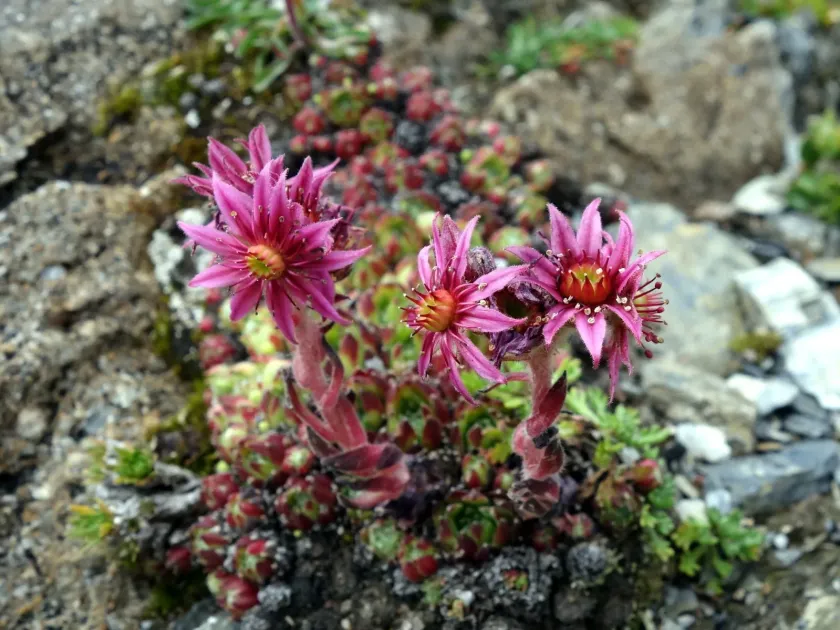
Description
Sowing dates
The Cobweb houseleek is a perennial succulent belonging to the Crassulaceae family, primarily propagated through vegetative division of the offset rosettes.
The most favorable period for planting and transplanting is during the active growth phase, typically from mid-spring to early summer.
While seed propagation is possible, it is commercially complex due to the minuscule size of the seeds, which require careful handling and controlled moisture.
When sowing, seeds should be scattered on the surface of a well-draining mineral substrate without being buried to ensure optimal light exposure for germination.
Seedlings or offsets should be placed at a distance sufficient to allow for expansion while maintaining a dense mat that prevents weed competition.
Growing requirements
Sempervivum barbulatum is highly adapted to rocky, poor soils and demonstrates significant physiological resistance to arid environmental conditions.
Exceptional drainage is mandatory; the crop cannot tolerate waterlogged conditions, which lead to rapid decay of the basal tissues and root system.
The crop requires full sun exposure to maintain the characteristic webbing and coloration of the rosettes, which are key quality indicators.
Soil pH should remain within the neutral range, as extreme acidity or alkalinity can negatively impact the nutrient uptake efficiency of the succulent leaves.
Given its drought tolerance, the species is increasingly utilized in modern agricultural landscaping and green roof installations requiring minimal irrigation.
Main diseases and pests
The primary threats to crop health are fungal diseases, such as botrytis or root rot, which are triggered by high humidity and lack of air movement.
Preventative agronomic practices include selecting sites with high airflow and strictly limiting irrigation to periods when the soil is completely dry.
Common insect pests include aphids and mealybugs, which congregate in the protected areas between the succulent leaves, causing stunted growth.
In outdoor field production, monitoring for soil-borne larvae, such as those of the vine weevil, is essential to protect the integrity of the root system.
- Maintaining adequate spacing to ensure good ventilation.
- Avoiding overhead irrigation that traps water in the rosettes.
- Applying targeted biological or chemical control if an infestation is detected.