
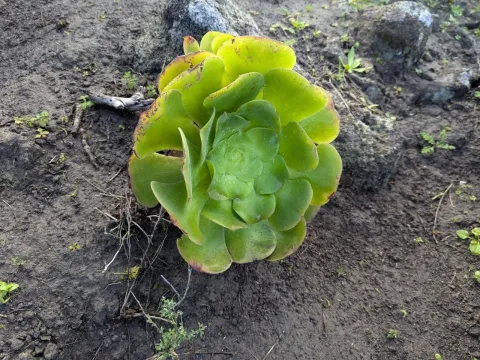
Aeonium
Aeonium
Aeonium is a genus of succulent plants belonging to the Crassulaceae family. Originally native to the Canary Islands, Madeira, and parts of East Africa, these plants have evolved to thrive in environments with seasonal rainfall and intense sunlight, making them highly specialized drought-resistant crops.
What the section contains
 Aeonium balsamiferum
Aeonium balsamiferum
Aeonium balsamiferum
 Aeonium canariense
Aeonium canariense
Aeonium canariense
 Aeonium castello-paivae
Aeonium castello-paivae
Aeonium castello-paivae
 Aeonium ciliatum
Aeonium ciliatum
Aeonium ciliatum
 Aeonium cuneatum
Aeonium cuneatum
Aeonium cuneatum
 Aeonium dodrantale
Aeonium dodrantale
Aeonium dodrantale
 Aeonium glandulosum
Aeonium glandulosum
Aeonium glandulosum
 Aeonium glutinosum
Aeonium glutinosum
Aeonium glutinosum
 Aeonium haworthii
Aeonium haworthii
Aeonium haworthii
 Aeonium hybrids
Aeonium hybrids
Aeonium hybrids
 Aeonium lancerottense
Aeonium lancerottense
Aeonium lancerottense
 Aeonium leucoblepharum
Aeonium leucoblepharum
Aeonium leucoblepharum
 Aeonium lindleyi
Aeonium lindleyi
Aeonium lindleyi
 Aeonium sedifolium
Aeonium sedifolium
Aeonium sedifolium
 Aeonium simsii
Aeonium simsii
Aeonium simsii
 Aeonium spathulatum
Aeonium spathulatum
Aeonium spathulatum
 Aeonium urbicum
Aeonium urbicum
Aeonium urbicum
 Golden Aeonium
Aeonium aureum
Golden Aeonium
Aeonium aureum
 Saucer plant
Aeonium tabuliforme
Saucer plant
Aeonium tabuliforme
Aeonium
The botanical structure of Aeonium features succulent leaves arranged in rosettes that grow at the end of woody stems. This morphology serves as a survival mechanism, allowing the plant to store water efficiently and maintain metabolic activity even during periods of physiological stress.
Agricultural requirements include a well-draining, porous substrate composed of volcanic grit, sand, and organic potting mix. Achieving the correct soil pH, which should be slightly acidic to neutral, is vital for nutrient uptake and the overall vitality of the root system.
Environmental conditions require at least six hours of direct sunlight daily to maintain the structural integrity of the rosettes. Excessive shading leads to etiolation, where stems become weak and leggy, significantly reducing the market value of the crop in commercial settings.
In terms of agricultural management, Aeonium is grown primarily for the floriculture market. Propagation is typically achieved through stem or leaf cuttings, which must be allowed to callus before planting to prevent rot, demonstrating a specific, high-maintenance approach to multiplication.
Primary pests that threaten commercial production include mealybugs and aphids, which feed on the sap of the succulent leaves. Integrated pest management (IPM) strategies, including biological controls or targeted insecticides, are recommended for large-scale operations.
Root rot, caused by various species of Pythium and Phytophthora, is the most common pathology. It occurs almost exclusively due to over-irrigation or inadequate drainage, requiring strict adherence to watering cycles and optimal greenhouse ventilation.