
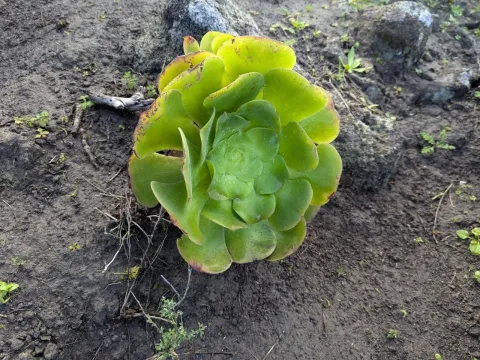
Aeonium
Aeonium Webb & Berthel.
Aeonium is a genus of succulent plants within the Crassulaceae family. Native primarily to the Canary Islands, Madeira, and parts of North Africa, these plants are well-adapted to rocky, arid environments with high solar exposure.
What the section contains


Aeonium
Botanically, these plants are known for their distinct, fleshy rosettes that grow at the ends of woody or semi-woody stems. Depending on the species, their appearance can range from small, ground-hugging forms to impressive, shrub-like structures.
The primary cultivation requirement is light. Aeoniums thrive in full sun or bright, filtered light. Insufficient light levels will cause the rosettes to lose their structural integrity, stretching out and losing their characteristic leaf pigmentations.
Soil composition must prioritize drainage. A specialized succulent or cactus mix is necessary, often amended with pumice, perlite, or grit to ensure that water passes through the roots quickly, preventing saturation.
Temperature management requires avoiding extreme fluctuations. While they tolerate heat well, they are not frost-hardy. Maintaining a cool, dry winter environment encourages dormancy and helps the plant recover for the next growing season.
Root rot is the most critical threat to Aeoniums, resulting almost exclusively from overwatering or poorly draining soil conditions that trap moisture around the base of the plant.
Mealybugs represent a significant pest challenge, frequently nesting within the tight rosettes. Their presence can be identified by the small, white, cotton-like masses they create on the foliage.
Aphids can occasionally colonize the soft, new growth of the rosettes, particularly during the active growing season, sucking sap and causing leaves to become stunted or curled.
Fungal infections, such as powdery mildew, may occur if the ambient humidity is high and airflow is insufficient, creating the perfect conditions for spores to propagate on the leaf surfaces.
To maintain health, growers should practice diligent monitoring, remove dead or dying leaves from the base of the rosettes, and apply neem oil or insecticidal soap at the first sign of pest infestation.