
Crassula sericea
Crassula sericea
Description
Growing requirements
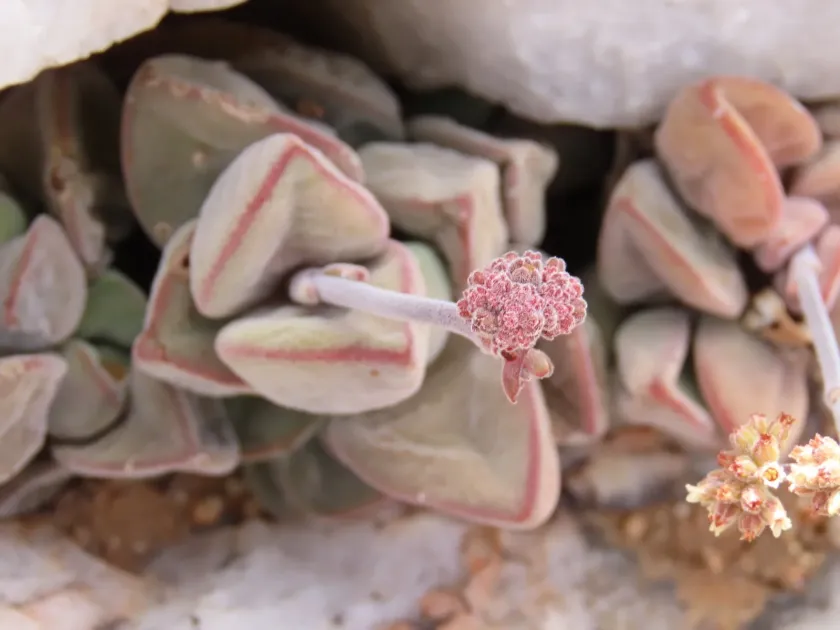
Crassula sericea is a succulent species belonging to the Crassulaceae family, native to the arid environments of South Africa. This plant is well-known for its distinctive velvety or silky leaf texture, which serves as a protective mechanism against extreme sunlight.
The cultivation of this plant requires specific soil conditions, characterized by excellent drainage and high mineral content. Using a specialized succulent mix comprising pumice, sand, and coarse grit is essential to prevent water accumulation near the root zone.
Regarding climate, Crassula sericea thrives in environments with high light intensity and moderate temperature fluctuations. During the growth cycle, the plant requires consistent sunlight to maintain its compact morphology and characteristic leaf structure.
Watering practices must be strictly controlled, adhering to the soak-and-dry method. During the dormant season, which typically occurs in winter, the plant should be kept almost completely dry to simulate its native seasonal cycle.
Propagation is primarily achieved through stem cuttings or leaves, allowed to callous before being placed in dry substrate. Seed propagation is also possible, requiring a sterile environment and high humidity initially, followed by a gradual reduction of moisture.
Main diseases and pests
The most significant threat to Crassula sericea is root rot, caused by overwatering or poorly draining soil. When the roots remain wet for extended periods, they become susceptible to fungal pathogens that destroy the plant from the base upwards.
Mealybugs are the most common insect pests, often found in the leaf axils or clustered around the growth points. Manual removal with a cotton swab dipped in isopropyl alcohol is an effective non-chemical control measure for small infestations.
Spider mites can also cause significant damage, especially in poorly ventilated environments. They feed on the sap, leading to stunted growth, leaf discoloration, and a loss of the unique velvety texture of the plant.
Fungal infections can arise if the plant is kept in high humidity without proper air circulation. Regular monitoring for spots or soft tissue changes is necessary to ensure the longevity of the succulent.
To maintain plant health, it is vital to keep the growing area clean and free of organic debris, which can serve as a breeding ground for harmful insects and pathogens.