
Yellow-flowered houseleek
Sempervivum leucanthum
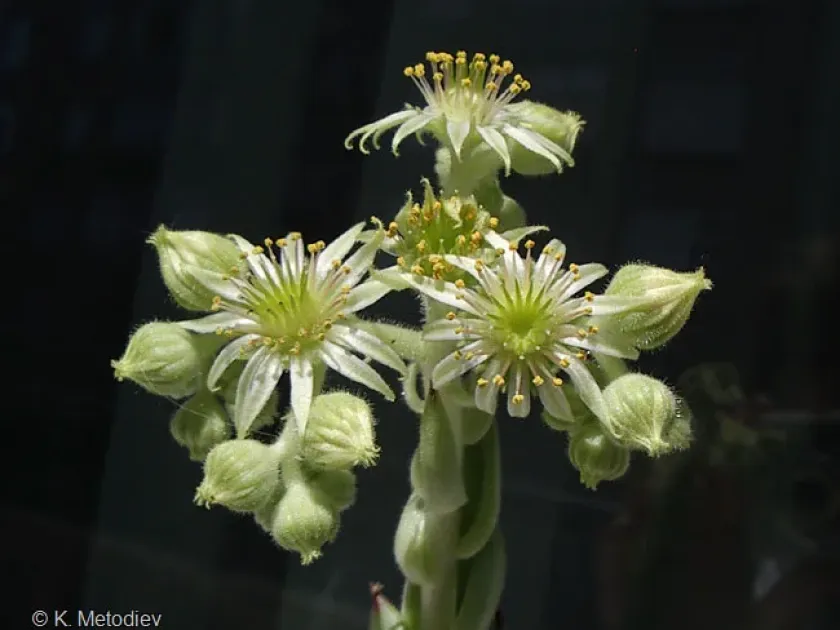
Description
Sowing dates
Sempervivum leucanthum, a member of the Crassulaceae family, primarily propagates through offsets or "chicks" that emerge from the parent "hen" rosette during the spring and summer seasons.
Seed propagation is possible in early spring, where seeds are sown in a gritty, well-draining substrate and require light and consistent warmth to germinate effectively.
Vegetative division is the preferred method for agricultural use, as it ensures the preservation of maternal traits and allows for rapid establishment of new colonies in rock gardens.
Spacing should be managed to accommodate the growth of new offsets, with a typical planting density of 9 to 16 plants per square meter for ground cover purposes.
Regular monitoring of young plants is recommended during the first few weeks after transplantation to ensure the soil remains barely moist until the root system stabilizes.
Growing requirements
Native to the mountainous regions of the Balkans, this species is highly adapted to nutrient-poor, stony soils and thrives in environments with high solar irradiance.
The plant requires full sun exposure to maintain its compact rosette form and intense leaf coloration; shaded areas often lead to etiolation and structural weakness.
Good drainage is the most critical factor for success; the substrate should consist of a mix of sand, grit, and minimal organic matter to prevent waterlogging.
Sempervivum leucanthum is exceptionally winter-hardy and requires no special protection from frost, making it an ideal choice for permanent alpine landscapes.
Maintenance tasks include the removal of dead leaves from the base of the rosettes to improve air circulation and prevent the development of localized fungal pockets.
Main diseases and pests
Root and crown rot represent the primary threats, typically induced by excessive moisture or soil compaction that inhibits gas exchange around the root zone.
Mealybugs are the most common pests, often sheltering in the tight crevices between leaves, where they consume plant sap and weaken the overall structure.
Slugs and snails can cause mechanical damage to the leaves, and in damp environments, their presence may necessitate the use of physical barriers or organic deterrents.
Fungal infections, such as rust or various leaf spot diseases, can occur if the humidity levels remain too high for extended periods, especially during rainy seasons.
To mitigate these risks, ensure that plantings are situated on slopes or raised beds, which naturally promote the rapid drainage of excess water away from the succulent tissue.