
Russian thistle
Salsola tragus L.
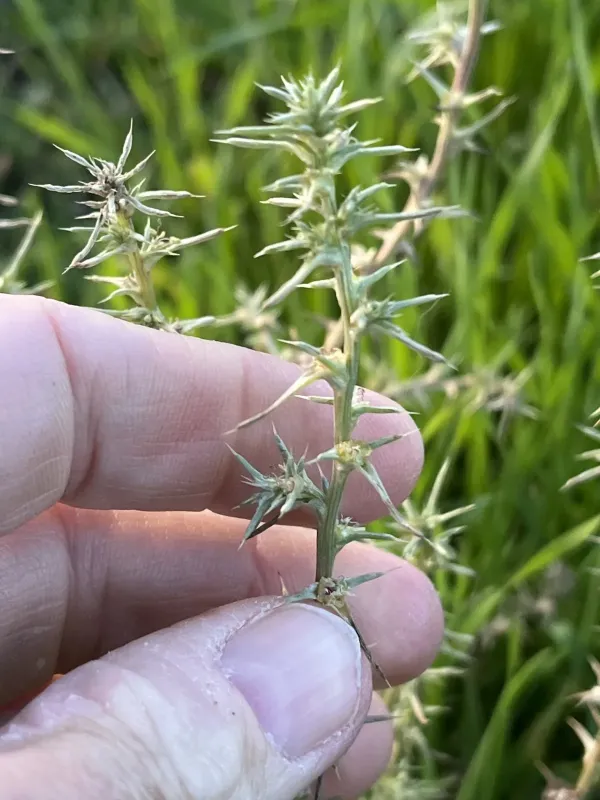
Description
Sowing dates
Russian thistle is a hardy annual herb belonging to the Amaranthaceae family, widely recognized for its tumbleweed growth habit. Seeds typically germinate in early spring as soil temperatures rise.
For agricultural cultivation, seeds should be sown in mid-spring, ensuring the soil has warmed sufficiently to support rapid initial development and root establishment.
The seeds require minimal soil coverage, as they need specific light conditions and consistent surface moisture to initiate the germination process effectively.
To ensure uniform growth, precision planting is recommended to avoid overcrowding, which can significantly stunt individual plant development and biomass yield.
In semi-arid regions, planting follows the onset of spring rains to maximize the usage of available soil moisture before the onset of summer heat.
Growing requirements
This plant is a highly efficient halophyte, capable of thriving in saline soils where traditional agricultural crops would fail to reach full maturity.
It prefers well-drained, sandy, or gravelly substrates and shows remarkable adaptation to nutrient-poor environments, making it suitable for marginal lands.
Full sun exposure is an absolute necessity for this species, as it lacks the physiological traits to survive in shaded or high-canopy environments.
It exhibits exceptional drought tolerance due to its specialized leaf anatomy, which reduces transpiration losses during periods of severe water scarcity.
Good soil drainage is essential for healthy plant development, as waterlogged conditions often lead to rapid root decay and plant mortality.
Yield
The biomass yield of Russian thistle varies depending on soil fertility and moisture levels, with productive stands yielding several tons of dry matter per hectare.
Nutritional value peaks during the pre-flowering stage, making this the critical window for harvesting to ensure optimal digestibility for livestock consumption.
While the plant responds positively to nitrogen fertilization, excessive input can cause lodging and decrease the overall structural integrity of the plant stand.
In dry environments, the plant consistently outperforms traditional forage, providing a reliable source of green matter when other crops are dormant.
Proper density management allows for easier harvesting and ensures that the total harvest reflects the plant's true potential in specific growing conditions.
Main diseases and pests
Russian thistle is generally robust, but it can be susceptible to fungal infections like powdery mildew when exposed to prolonged periods of high humidity.
Specific insect pests, such as various weevils and plant bugs, may target the vegetative parts, potentially reducing the overall quality of the forage.
Under heavy infestation, minor pest management is necessary; however, the plant’s rapid growth rate often allows it to overcome minor physical damage.
Root-knot nematodes can pose a problem in intensive cropping systems if proper rotation practices are not strictly followed over several seasons.
To mitigate health issues, maintaining clean field edges and ensuring good air circulation within the stand are effective cultural control strategies.
Harvesting
Harvesting for forage should occur before the plants develop woody, spiny stems, as the lignification process significantly reduces palatability for livestock.
Mechanical harvesting involves cutting and windrowing to allow the material to dry uniformly, preserving the essential proteins and mineral content.
When collecting seeds, direct combining is the preferred method during the stage when fruits turn brown, preventing excessive shattering in the field.
Care must be taken to store harvested forage in well-ventilated structures to prevent moisture accumulation and the subsequent development of mold.
Timely harvest is critical, as a delay leads to the plants becoming brittle and rolling away, resulting in a total loss of the harvestable biomass.