
Red flowering gum
Corymbia ficifolia (F. Muell.) K. D. Hill & L. A. S. Johnson
Description
Growing requirements
The Red flowering gum is an evergreen tree belonging to the Myrtaceae family. In its natural environment, the plant reaches heights of 6 to 15 meters, forming a dense and spreading canopy.
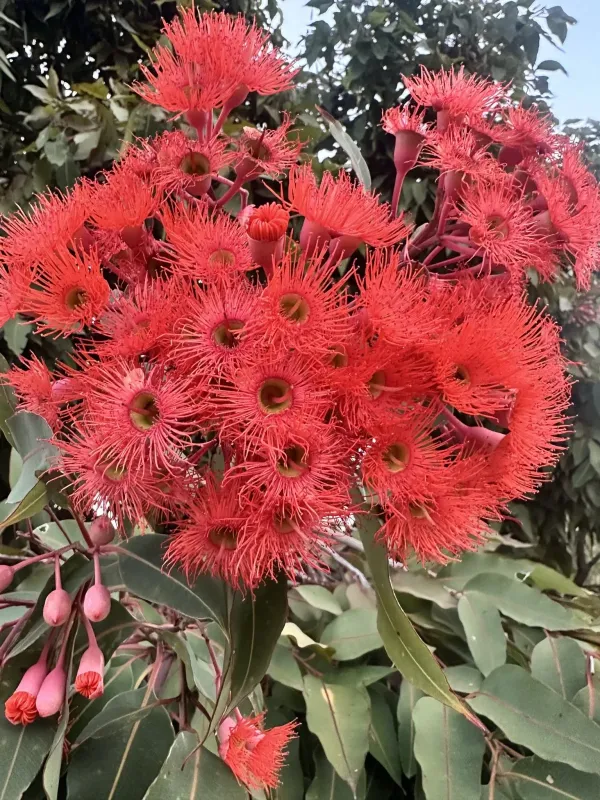
This culture originates from the southwestern regions of Western Australia, where it thrives in sandy soils. In cultivation, it is highly valued for its abundant and vibrant flowering, where brilliant red blooms almost entirely cover the foliage.
The plant prefers well-drained, slightly acidic to neutral soils. A crucial requirement is full sun exposure, as decorative appeal and flowering intensity diminish significantly in shaded conditions.
The climate preferences of Corymbia are restricted to Mediterranean-type climates. It does not tolerate prolonged frosts well, so in temperate regions, it is mainly grown in greenhouses or as a container plant.
In landscaping, the tree is used as an accent specimen or for avenue plantings. Beyond its aesthetic value, Corymbia is a valuable nectar source that attracts numerous birds and pollinating insects.
Main diseases and pests
The main threats to the plant are fungal diseases that develop when the soil is overly moist. Root rot (Phytophthora) frequently affects young saplings during periods of waterlogging.
Among pests, various species of scale insects are the most common, feeding on the sap of young shoots and leaves. Weakened trees can also be attacked by leaf-eating insects.
Regular inspection of the underside of the leaves allows for the early detection of parasite colonies. If necessary, the application of systemic insecticides according to the manufacturer's instructions is recommended.
To prevent pathogens, it is necessary to adhere to a proper watering regimen, avoiding constant saturation of the root zone. Applying mineral fertilizers containing iron helps prevent leaf chlorosis.
Removing dead and damaged branches during the dormant period promotes better crown ventilation. Good aeration is key to the plant's health and prevents the development of fungal infections in dense canopy areas.