
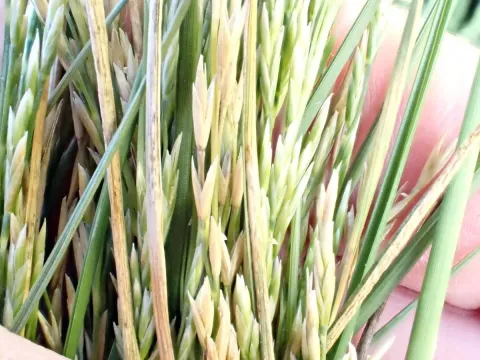
Alkali grass
Puccinellia
Sowing of alkali grass is carried out mainly in early spring, as soon as the soil becomes physically ready, which allows for the most efficient use of winter moisture reserves. In southern regions, autumn sowing is permissible, ensuring earlier emergence in the following season.
What the section contains


Alkali grass
The seeding depth should be minimal, as the seeds of this grass are very small; it is optimal to sow them at a depth of no more than 1–2 centimeters. Deep planting sharply reduces germination rates, requiring the use of high-quality seed drills with precise settings.
The seeding rate depends on the intended use: it is higher for creating intensive pastures than for producing seed material. Usually, with a broadcast or row-seeding method, 8 to 12 kilograms of seeds per hectare are applied.
After sowing, it is recommended to roll the field to improve seed-to-soil moisture contact, which is critical for uniform germination. Alkali grass is characterized by slow initial growth, so ensuring the fields are free of weeds during the first year is vital.
In subsequent years, the stand recovers through vegetative spreading and self-seeding, making the crop long-lived and economically advantageous in arid climates.
Alkali grass is a unique halophyte belonging to the Poaceae family, perfectly adapted to life in highly saline soils. It is one of the few crops capable of producing a full yield where other grasses perish from osmotic stress.
The plant possesses high ecological plasticity, withstanding both short-term flooding and long periods of drought. Its root system penetrates deep, effectively utilizing soil resources and strengthening the soil structure.
For normal development, the crop requires open, well-lit areas, as it is extremely photophilic. It thrives on solonchaks, solonetz soils, and coastal lowlands, displacing less resilient plant species.
Temperature is not a strict limiting factor, as alkali grass possesses excellent frost resistance and can tolerate harsh winters. It begins vegetation immediately after the snow melts, providing early access to green forage for livestock.
It is relatively undemanding regarding soil fertility, though on sites with extreme salinity, applying starter doses of nitrogen fertilizers significantly increases green biomass.
The yield of alkali grass depends directly on the level of salinity and soil moisture, varying within wide limits. In favorable years, on reclaimed solonetz soils, up to 4–6 tons of hay per hectare can be obtained from a single cut.
The first cut usually offers the best nutritional quality, as the grass accumulates maximum nutrients before the summer heat. Subsequent regrowth after mowing provides a significantly smaller volume of biomass.
When used as a pasture plant, productivity is evaluated by the weight gain of livestock. Alkali grass is characterized by high palatability, making it a valuable component of seed mixtures for saline grazing lands.
Seed productivity ranges from 200 to 500 kilograms per hectare, and it is critical to prevent seed shattering during harvest. Ripening occurs unevenly, which requires constant monitoring of the ear condition.
To maintain high productivity in perennial stands, periodic harrowing is recommended, which stimulates tillering and prevents stand degradation.
Alkali grass has natural resistance to many diseases typical of cultivated cereals. However, under conditions of high humidity and dense stands, the development of rust, which affects the leaf blade, is possible.
Pests such as cereal flies may cause local damage in the early stages of vegetation. However, due to specific growth conditions (high salt concentration), most typical pests avoid these areas.
Weeds are the main threat to young stands, as they can suppress seedlings in the first year. Therefore, agronomy must include weed control before the alkali grass gains strength.
Poor grazing management, leading to overgrazing, results in thinning of the stand and replacement by less valuable weeds. Controlled grazing is an important tool for phytosanitary control.
To prevent the spread of fungal diseases in seed fields, it is recommended to maintain spatial isolation and perform timely harvesting of seed crops immediately after ripening.
Mowing alkali grass for hay should be done at the heading phase, when protein and sugar content in the plant reach their maximum. Over-ripening leads to a sharp decline in forage value as the stems quickly become coarse.
Seed harvesting is conducted in two stages by mowing into windrows, where seeds continue to ripen. Once seed moisture reaches about 14%, threshing is performed to ensure the quality of planting material.
When used for pasture, strict rotational grazing is necessary to allow plants time to regrow. Grazing height should be at least 5–7 centimeters to preserve the growing point.
Harvested hay is highly nutritious and aromatic, making it eagerly consumed by all types of livestock. It is important to dry the hay to a safe moisture level to prevent mold in the stacks.
Harvesting requires an operational approach, as the optimal ripening phase for mowing is very short. Using modern machinery helps reduce losses and improve the commercial quality of the final product.