
Common saltmarsh-grass
Puccinellia maritima (Huds.) Parl.
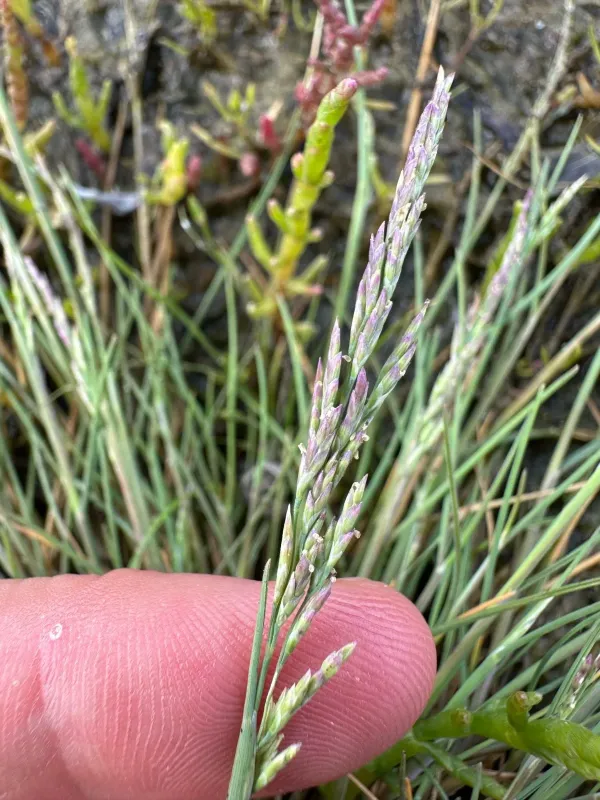
Description
Sowing dates
Seeding is best performed in the spring when soil temperatures allow for active germination. The seeds are very small and require careful management to ensure they are not planted too deeply, which is a common error in large-scale seeding.
Successful establishment relies on ensuring consistent surface moisture. In saline conditions, it is often beneficial to sow into existing, sparse vegetation or lightly disturbed soil to protect the seedlings from high wind and surface salt crusts.
Sowing rates should be adjusted based on the specific salinity level of the site. On very harsh, bare saline flats, higher seed density is recommended to ensure that the ground cover closes rapidly through stolon extension.
During the first growth season, the plant focuses primarily on root development. Minimal traffic and grazing should be permitted during this phase to allow the grass to anchor itself properly into the challenging substrate.
Techniques such as direct drilling are preferred for restoring degraded salt marshes. This approach minimizes soil disturbance while ensuring that seeds are placed at the optimal depth for consistent germination and survival.
Growing requirements
Common saltmarsh-grass (Puccinellia maritima) is a perennial grass species belonging to the Poaceae family. It is a highly specialized halophyte naturally adapted to thriving in saline environments, including coastal salt marshes and brackish meadows.
The plant originates from the coastal regions of Europe, where it has evolved to withstand periodic flooding by seawater. Its ability to tolerate high salinity levels allows it to inhabit areas that are completely unsuitable for standard agricultural crops.
Regarding soil requirements, Puccinellia maritima prefers heavy, saline soils. It performs exceptionally well on clay-rich substrates found in tidal zones, demonstrating a remarkable resilience to both high pH levels and high mineral concentration.
Climate adaptation is a key feature of this grass. It thrives in temperate maritime climates, benefiting from regular moisture and avoiding extreme desiccation. It is well-suited for regions exposed to strong winds and saline mist.
Ecologically, the plant plays a vital role in stabilizing coastal ecosystems. Its extensive root system and dense stoloniferous growth habit create a robust turf that effectively binds the soil, protecting fragile shorelines from erosion.
Yield
The biomass yield of common saltmarsh-grass varies depending on the salinity gradient and nutrient availability. In productive saltmarsh conditions, it provides a high-quality forage source for livestock, particularly sheep.
Its forage value is well-regarded in coastal agriculture, as the plant remains palatable even when grown on saline soils that would render other grasses bitter or stunted. This makes it a crucial resource for pastoral farmers in maritime regions.
The grass is also highly valued for its contribution to land reclamation. By fixing nitrogen in the soil and improving its structure through root activity, Puccinellia maritima acts as a pioneer species for saline land rehabilitation.
Harvesting for hay is possible, though grazing is the more common management strategy. When cut for hay, the high protein content of the foliage makes it a nutritious winter feed, provided it is harvested at the peak of vegetative growth.
Long-term yield sustainability is achieved through controlled grazing patterns. Allowing the grass sufficient rest periods between grazing cycles ensures that the stolons remain healthy and capable of vegetative regrowth.
Main diseases and pests
Common saltmarsh-grass is notably resistant to most common plant diseases due to its harsh habitat, which naturally limits the proliferation of many agricultural pathogens found in fresh-water meadows.
However, in stagnant water or under conditions of extreme organic accumulation, fungal infections such as rust may occur. Proper water management and ensuring adequate drainage can significantly reduce these risks.
Pest pressure on Puccinellia maritima is generally low. The plant's high salt concentration acts as a natural deterrent, making it less susceptible to the insect attacks typically seen in high-input farming environments.
The greatest threat to a healthy stand is overgrazing. Excessive mechanical pressure on the soil surface can lead to compaction and damage the fragile stolons, causing the turf to thin and become prone to weed invasion.
Effective management involves monitoring stocking rates closely. By rotating grazing areas, farmers can protect the integrity of the turf, ensuring the grass remains a permanent and productive feature of the coastal landscape.