
Clove basil
Ocimum gratissimum L.
Description
Sowing dates
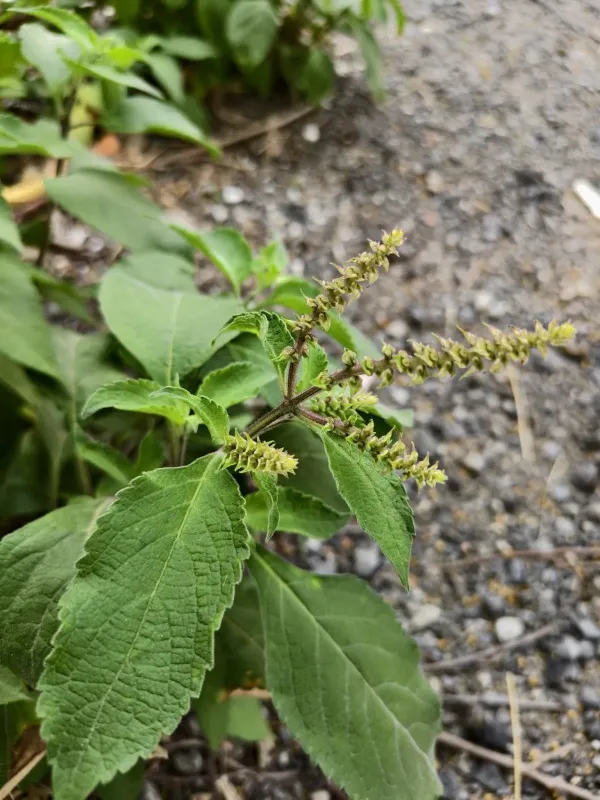
Clove basil (Ocimum gratissimum L.) is a perennial subshrub belonging to the Lamiaceae family. While it thrives in tropical regions as a perennial, in temperate agriculture, it is managed as an annual crop due to its extreme sensitivity to frost.
Propagation typically begins indoors in early spring. The seeds require warmth and consistent moisture to germinate; maintaining a substrate temperature of 20–25 degrees Celsius is essential for achieving a high germination rate within the first two weeks.
Transplanting into the field is carried out once the risk of spring frosts has completely passed. The crop is spaced out to allow for sufficient airflow and development, typically with 60 cm between rows and 30–40 cm between individual plants in the row.
Soil preparation should be completed well in advance, focusing on organic amendment to provide sufficient nutrients for rapid leaf development. A well-drained, fertile, and light soil structure is crucial for the root system to establish effectively.
Weed management during the early growth stages is critical for the crop's establishment. In commercial settings, mechanical cultivation of the inter-rows is common to minimize competition for nutrients and moisture while maintaining soil aeration.
Growing requirements
This crop is highly thermophilic, meaning it requires warm temperatures to thrive. A range of 22–28 degrees Celsius is considered optimal; significant deviations from these temperatures can impair the development of essential oil glands.
Full sun exposure is a mandatory requirement for Clove basil. Sunlight is the primary driver for the biosynthesis of eugenol, the main component of its essential oil. Shade significantly reduces both biomass yield and oil quality.
Water availability must be consistent, particularly during the vegetative phase. While the crop requires regular irrigation, the soil must not become waterlogged, as Clove basil is highly susceptible to root rot in poorly drained conditions.
Nutrient requirements are primarily focused on nitrogen and potassium. Nitrogen supports the rapid accumulation of leafy biomass, while potassium plays a vital role in the metabolic pathways that lead to the concentration of essential oils in the foliage.
Rotation cycles are essential to prevent the buildup of soil-borne pathogens. Integrating Clove basil into a rotation with crops from different botanical families ensures soil health and reduces the need for chemical intervention.
Yield
Yield productivity is contingent upon the climate and the number of cuttings achieved per season. In ideal, warm conditions, multiple harvests are possible, significantly increasing the total biomass produced per hectare.
Under optimal agricultural management, Clove basil can yield approximately 15 to 25 tons of fresh green matter per hectare. The quality of this yield is determined by the specific timing of the harvest during the plant's phenological cycle.
The essential oil yield varies significantly depending on plant maturity. Harvesting at the stage of mass flowering ensures the highest concentration of eugenol, providing the best return for processing facilities focused on oil extraction.
Efficiency in harvesting and logistics is paramount. The time between cutting the crop and starting the steam distillation process directly affects the final yield of the essential oil, as the volatile components are prone to evaporation.
Overall, Clove basil is considered a high-value industrial crop. The economic viability depends on localized processing capabilities and the ability to maintain the high quality of the raw material from the field to the distillery.
Main diseases and pests
Fusarium wilt is a primary biological threat to Clove basil plantations. It is a soil-borne fungal disease that invades the vascular system, causing systemic wilting and eventual death, especially in poorly drained or overheated soils.
Powdery mildew represents another common concern, particularly in environments with high humidity or poor air circulation. It manifests as a white mycelial layer on the leaves, which inhibits photosynthesis and reduces the overall quality of the essential oil.
Pests such as aphids and spider mites are frequent invaders. These insects extract sap from the foliage, causing physical damage and potentially acting as vectors for viral infections, which can stunt the growth of the young basil plants.
Slugs and snails can cause localized damage, particularly in moist conditions or areas with high amounts of organic debris. Biological controls and the removal of hiding spots are recommended methods for mitigation.
Proactive monitoring is essential for effective pest management. By identifying and removing infected plants early, farmers can prevent the spread of disease across the field and maintain the overall vigor of the plantation.
Harvesting
Harvesting is ideally performed when the plants reach the mass flowering stage. At this point, the metabolic activity directed towards producing secondary metabolites like eugenol is at its peak, yielding the highest concentration of oil.
Mechanical harvesting tools are used to cut the plants at an optimal height of approximately 10–15 cm from the soil surface. This height allows the plant to recover quickly and produce regrowth for subsequent harvests during the same season.
Dry weather is crucial for harvesting; moisture on the leaves can lead to premature fermentation and heat buildup within the harvested biomass. Harvesting should occur in the morning after dew has evaporated but before the intense afternoon heat.
Logistical speed is essential for moving the green mass to the processing facility. Large, compressed heaps of cut plant material should be avoided as they trap heat and accelerate the degradation of delicate aromatic compounds.
If immediate distillation is not possible, the material must be spread out in a well-ventilated, shaded area to dry slightly, preventing the loss of volatile essential oils and maintaining the freshness of the plant material.