
Casuarina junghuhniana
Casuarina junghuhniana Miq.
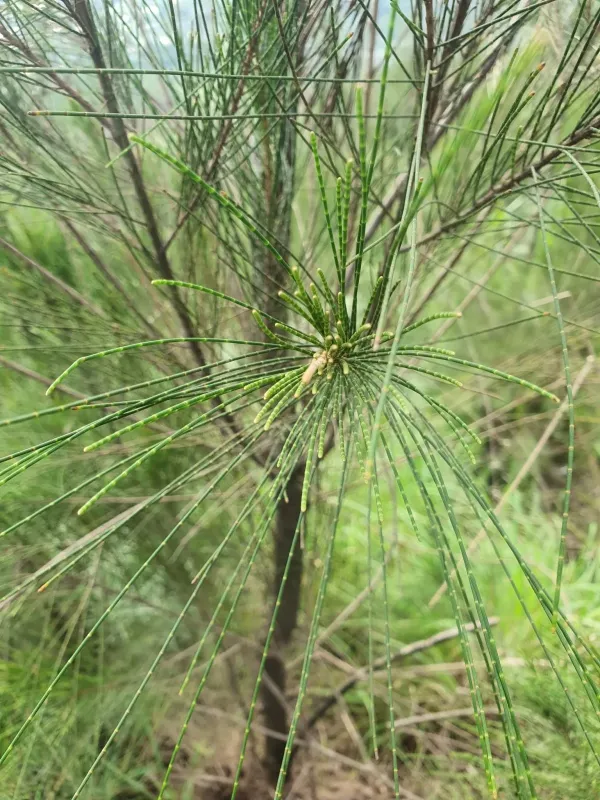
Description
Sowing dates
Propagation of Casuarina junghuhniana is primarily achieved through seeds or cuttings in specialized nursery environments. In tropical regions, seeds are sown in containers with lightweight substrate, requiring consistent moisture for germination.
Seedling preparation for field planting typically spans four to six months. It is vital to monitor root development to prevent spiraling inside containers, as this significantly impacts the survival rate after transplantation.
Field planting is ideally conducted at the beginning of the rainy season to ensure young plants have sufficient moisture for adaptation. Planting density varies by use, with forestry plantations typically featuring 2500 trees per hectare.
Young plantations require diligent weeding in the early years, as the culture is sensitive to competition from invasive grasses. Regular maintenance allows the tree to rapidly establish its main stem and accumulate biomass.
A crucial aspect of agronomy is the inoculation of soil with nitrogen-fixing bacteria (Frankia). This symbiosis allows the tree to thrive even in nutrient-poor soils without the need for intensive fertilization.
Growing requirements
Casuarina junghuhniana is an evergreen tree of the Casuarinaceae family, native to Southeast Asia, particularly Indonesia. The species is highly valued for its plasticity and ability to survive in diverse, harsh environments.
The plant thrives in sunny, open areas with well-drained soil. It exhibits exceptional tolerance to saline conditions and strong winds, making it an ideal choice for coastal afforestation and windbreak systems.
Once established, the tree demonstrates high drought tolerance. While it prefers temperatures between 20 and 30 degrees Celsius, it is capable of enduring significant fluctuations throughout the year.
The tree has low soil quality requirements and adapts well to sandy, rocky, or degraded terrain. Due to its symbiotic nature, it effectively enriches the surrounding soil with nitrogen.
The species requires minimal mineral fertilizers due to its adaptive survival mechanisms, though it responds positively to moderate irrigation during the first months after transplantation.
Yield
Casuarina junghuhniana is recognized as one of the fastest-growing tree species in tropical and subtropical regions. Under favorable conditions, it achieves commercial timber dimensions within 7 to 10 years.
The timber produced is characterized by high density and strength, making it excellent for construction and utility poles. It is also noted for its high resistance to rot and insect damage.
Average annual biomass growth can reach 20 to 30 cubic meters per hectare in well-managed plantations. This potential makes it a highly profitable investment for sustainable forestry.
Commercial utilization of the wood includes the production of premium-quality charcoal and fuel. Its calorific value is comparable to that of high-quality hardwood tree species.
To optimize yields, foresters perform thinning and sanitary logging, which allows the remaining trees to develop larger, higher-quality trunks for harvesting.
Main diseases and pests
The primary biological threats to plantations are fungal diseases affecting the root system. Waterlogging often triggers root rot, leading to high mortality rates in young and mature stands alike.
Among pests, stem-boring insects and termites present the greatest danger to young saplings. Regular phytosanitary monitoring is essential to detect and control pest populations before they cause damage.
Improper agronomic management, such as poor drainage, remains the highest risk factor. Ensuring an appropriate water-air balance in the root zone is crucial for long-term survival.
Diseases caused by rust fungi may affect foliage, reducing the photosynthetic rate and overall productivity. Immediate removal of infected branches is necessary to prevent widespread contagion.
Plantation protection relies on a combination of biological treatments and maintaining optimal planting density to ensure the trees can defend themselves through natural resilience.