
Mesembryanthemum guerichianum
Mesembryanthemum guerichianum
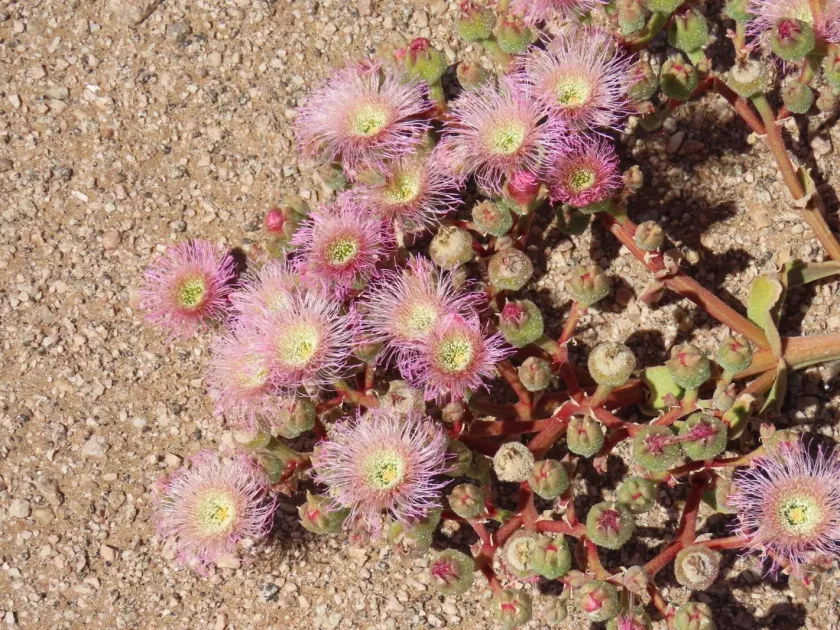
Description
Sowing dates
Mesembryanthemum guerichianum is a heat-loving species, requiring stable warm temperatures to germinate and thrive. The sowing process should be initiated only when the risk of night frost has completely passed and the soil has warmed up to at least +15–18°C.
For field production, light and well-drained soil is essential to ensure healthy root development. Seeds should be sown at a shallow depth, given their small size, and lightly pressed into the soil to ensure proper moisture contact.
Spacing between rows is crucial to allow for sufficient air circulation and light penetration. Wider rows generally facilitate easier maintenance and reduce the risk of humidity-related issues within the crop stand.
Consistent soil moisture is required only during the germination and early seedling stages. Once established, the plants demonstrate high resilience to dry conditions, requiring less frequent irrigation.
Industrial planting usually employs mechanical seeders set for low-depth distribution to optimize plant density and maximize uniform biomass development across the field.
Growing requirements
This species belongs to the Aizoaceae family and is native to the arid regions of Southern Africa. It has evolved to survive in extreme environments characterized by long periods of drought and high heat.
The plant is a succulent, featuring thick, water-storing leaves that allow it to remain productive during periods when water availability is severely limited. This makes it an ideal candidate for cultivation in arid environments.
The soil must have excellent drainage properties; sandy or loamy soils are ideal. Waterlogging is the most significant threat to this crop, as it quickly leads to root rot and loss of plant vigor.
Maximum solar exposure is necessary for the plant to achieve its potential growth rate. Shade reduces the photosynthetic efficiency and makes the plants susceptible to fungal infections.
Mesembryanthemum guerichianum is also known for its ability to tolerate saline conditions, offering an advantage in areas where soil salinity prevents the growth of traditional staple crops.
Yield
Yield production depends largely on the management of soil drainage and light exposure. In optimal conditions, the plant generates significant vegetative biomass that can be used for various industrial and nutritional purposes.
Its primary agricultural application is as a forage crop in dry climates where traditional grasses cannot survive. The high mineral content of the leaves provides valuable nutrients for livestock.
Beyond forage, the plant is being researched for its potential in food production, particularly as a nutrient-dense functional ingredient. Its ability to grow on degraded land adds to its agricultural significance.
Harvesting is usually timed before the flowering stage, as this is when the nutritional profile of the leaves is at its peak. Proper timing is essential to ensure the best quality of the raw biomass.
Yield stability is a notable characteristic of this species, as it maintains production levels even during seasons with irregular rainfall, providing a reliable safety net for farmers.
Main diseases and pests
The main threats to this crop are associated with excess humidity. High air humidity or waterlogged soil facilitates the development of various fungal pathogens, including root rot and powdery mildew.
Insects such as aphids and spider mites can become problematic during hot, dry spells. They cause damage by sucking sap from the leaves, which hinders plant growth and spreads secondary infections.
- Root rot due to poor soil drainage.
- Powdery mildew in high-humidity conditions.
- Slugs and snails affecting young seedlings.
Integrated pest management is recommended, focusing on early detection and biological control methods. Chemical intervention should be minimized to maintain the crop's ecological integrity.
Maintaining a strict crop rotation schedule is vital to prevent soil-borne pathogens from building up over consecutive growing seasons. At least a three-year gap is advised between planting cycles.
Harvesting
Mechanical harvesting is the preferred method for large-scale production, using mowers set at a specific height to avoid soil contact. Cleanliness of the biomass is essential for quality control.
Harvesting should be done during dry weather to reduce moisture content in the tissue, which significantly accelerates the drying process and prevents spoilage during subsequent storage.
Post-harvest handling requires immediate clearing of weeds and debris from the crop material. Efficient processing is necessary to preserve the nutritional and mineral content of the biomass.
Storage facilities must be dry and well-ventilated to prevent heat build-up and fungal growth. Proper temperature control ensures that the harvested material remains stable for long periods.
Any remaining plant residue after harvest is rich in organic matter and minerals, making it an excellent natural fertilizer when incorporated back into the soil during field preparation.