
Marcgravia brownei
Marcgravia brownei
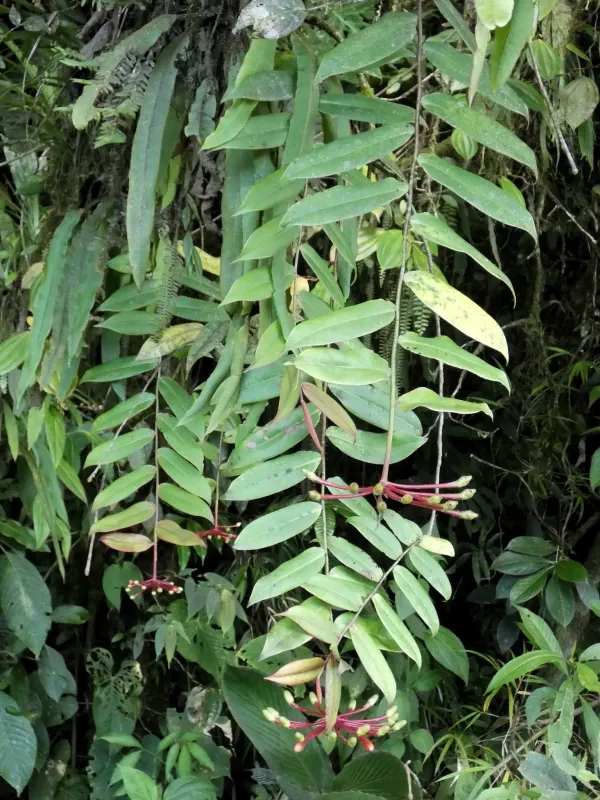
Description
Growing requirements
Marcgravia brownei belongs to the Marcgraviaceae family, representing a group of woody evergreen vines native to the tropical forests of Central and South America. It is highly valued in botanical collections for its unique climbing habit.
The plant exhibits significant heterophylly, a biological phenomenon where the leaf morphology changes drastically as the vine matures. Juveniles often produce small, flattened leaves, whereas adult plants develop larger, distinct foliage that gives the plant a lush, exotic appearance.
Successful cultivation requires a stable tropical environment with temperatures consistently ranging between 22 and 28 degrees Celsius. Protection from cold drafts and sudden temperature fluctuations is essential for long-term health.
The substrate must be light, airy, and rich in organic matter. A well-draining mixture containing peat, bark, and perlite is recommended to prevent waterlogging, which the root system is extremely sensitive to.
Bright, filtered light is the ideal lighting condition, as direct sunlight can scorch the foliage. High atmospheric humidity, ideally maintained above 70%, is required to mimic its natural epiphytic or semi-epiphytic habitat.
Main diseases and pests
Common pests include spider mites and mealybugs, which tend to congregate on the underside of leaves or in the axils of the stems. Early detection is crucial, especially when the plant is kept in indoor or greenhouse conditions with low airflow.
Root rot caused by fungal pathogens is the most frequent disease, usually triggered by overwatering or compacted, poorly drained soil. Maintaining a balance in irrigation is the best preventative measure to keep the root system healthy.