
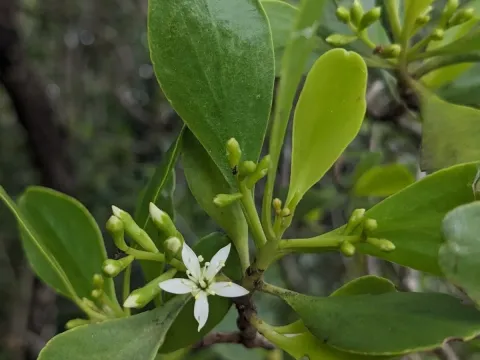
Lumnitzera
Lumnitzera
Lumnitzera is a genus of mangrove trees and shrubs belonging to the Combretaceae family. These plants are primarily native to the tropical regions of the Indo-Pacific, spanning from the east coast of Africa across to the islands of the Pacific and northern Australia.
What the section contains


Lumnitzera
As a highly specialized halophyte, Lumnitzera thrives in intertidal zones where it endures high salinity levels and periodic seawater inundation. Its physiological adaptations allow it to survive in anaerobic substrates where other vegetation typically fails.
The climate requirements for Lumnitzera include consistent tropical temperatures and high atmospheric humidity. It is strictly limited to frost-free regions, as it cannot survive even brief periods of cold, making it a key component of tropical coastal biodiversity.
Botanically, these plants feature leathery, succulent-like leaves and strong, durable wood. Their root systems are designed for stability in unstable, muddy soil, acting as a crucial anchor that prevents coastal erosion during severe storm events.
Economically, Lumnitzera wood is highly regarded for its strength and resistance to decay, making it suitable for construction, posts, and high-grade charcoal. Additionally, its role in protecting shorelines provides invaluable ecosystem services to local coastal communities.
Pollution from agricultural runoff and industrial waste poses a severe threat to Lumnitzera habitats. Chemical contaminants in the sediment can damage root systems, inhibiting gas exchange and leading to the eventual decline of entire mangrove stands.
Pests and pathogens, including certain wood-boring marine organisms, can cause localized damage to the trees. While these are natural interactions, outbreaks can become more destructive when the plants are stressed by environmental degradation.
Human activities, particularly the conversion of mangrove forests into aquaculture ponds for shrimp farming, represent a major risk. This practice results in habitat loss, fragmentation, and a permanent reduction in the natural range of the species.
Changes in freshwater flow patterns significantly affect the salt balance in estuaries, which is critical for Lumnitzera survival. Alterations in salinity levels can inhibit seed germination and lower the success rate of young saplings.
Climate change and rising sea levels pose a long-term danger to Lumnitzera populations. As coastal zones shift, the plants require space to migrate inland; however, coastal development often prevents this natural retreat, leading to potential regional extinctions.