
Korthalsia junghuhnii
Korthalsia junghuhnii
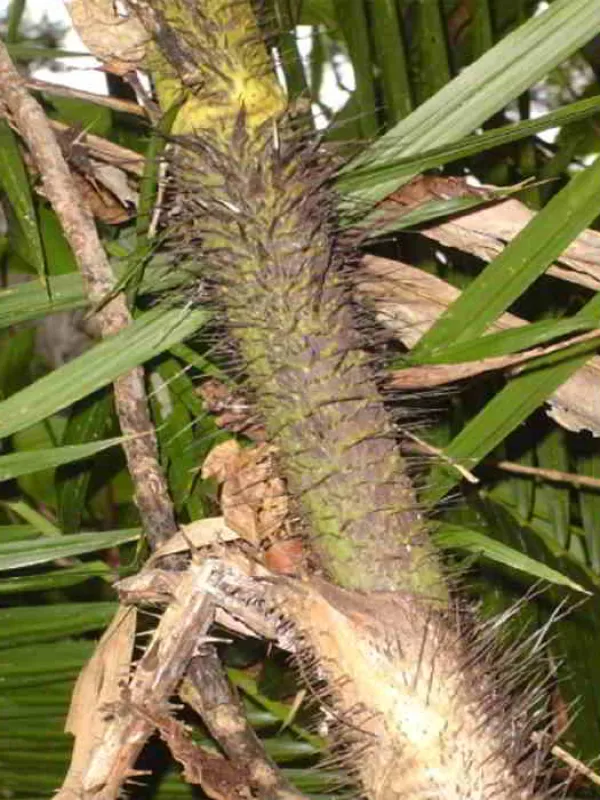
Description
Sowing dates
Korthalsia junghuhnii is propagated primarily through seeds collected from mature, healthy palm fruits in the wild or cultivated plots.
Seeds must be cleaned of their fleshy pericarp immediately after harvest to reduce the risk of microbial contamination and rot during germination.
Nursery beds should be prepared with a well-draining, nutrient-rich substrate, maintaining high moisture levels under artificial or natural shade.
The germination period can be extended, requiring patience and stable temperature management between 25 and 30 degrees Celsius.
Seedlings are typically transplanted to their permanent forest sites once they have developed several leaves and reach a height of approximately 40 centimeters.
Growing requirements
As a member of the Arecaceae family, this species is a climbing rattan palm that requires sturdy trees for vertical support as it grows.
It thrives in tropical climates characterized by consistent rainfall and high humidity levels throughout the entire calendar year.
Soil requirements include deep, fertile alluvial soils that prevent waterlogging but remain sufficiently damp for active root absorption.
The plant is highly sensitive to cold temperatures and dry spells, necessitating a microclimate found within forest ecosystems or managed plantations.
- Protection from excessive direct sunlight.
- Access to vertical supports such as trees or bamboo structures.
- Regular weeding in the vicinity of young plants to ensure nutrient access.
Yield
The primary economic output is the long, flexible stem, which is commercially harvested as a high-quality type of rattan for furniture making.
Sustainable yield is achieved by selectively harvesting mature stems while allowing the crown of the palm to continue its growth.
The maturation process for harvesting typically spans 8 to 12 years, depending on the site conditions and the availability of nutrients.
Quality control during yield assessment focuses on stem diameter, flexibility, and the absence of insect-induced blemishes or structural rot.
Efficient processing of the stems involves stripping away protective scales and curing the rattan to ensure long-term durability in furniture applications.
Main diseases and pests
Fungal diseases are a major threat, particularly in environments with poor air circulation where moisture persists on the foliage and stems.
Boring insects can penetrate the stem, significantly lowering the market value and mechanical strength of the harvested rattan material.
Habitat loss due to land conversion poses a serious risk to the long-term survival of the species in its natural, undisturbed environment.
Over-harvesting without allowing for sufficient regeneration time can lead to the exhaustion of local stocks within the forest ecosystem.
Wild herbivores can cause severe damage to young palm shoots, which may stunt growth or kill the plant if the growing tip is destroyed.
Harvesting
Harvesting is a skilled manual process, requiring workers to carefully pull stems from the forest canopy without damaging the plant's heart.
Standard safety gear is mandatory due to the presence of sharp, hook-like spines covering the stems of many Korthalsia species.
Once cut, the stems are measured and bundled immediately to facilitate easier extraction from the dense forest environment to collection points.
Post-harvest treatment involves basic cleaning and sun-drying or kiln-drying to stabilize the moisture content of the rattan fibers.
Proper harvest cycles promote the longevity of the plant, as the root system often supports the growth of new stems after older ones are removed.