
Chaga
Inonotus P. Karst.
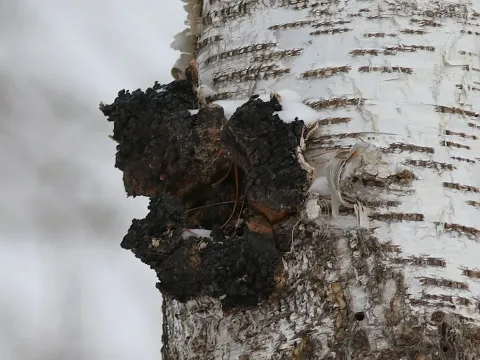
Chaga (Inonotus obliquus) is not a crop in the traditional agricultural sense, as it is a parasitic fungus that primarily infects the trunks of birch trees. The "sowing" process occurs naturally via spores that enter through damaged areas of the host tree's bark.
What the section contains

Chaga
Artificial cultivation of Chaga is an extremely difficult task, requiring the inoculation of mycelium into specifically prepared cuts or holes in living tree trunks. This process demands strict adherence to sterility and specific temperature conditions for successful infection.
The life cycle of Chaga is very long and can take from 10 to 20 years before a full-grown conk suitable for harvesting is formed. Accelerating this process in laboratory or industrial settings is currently limited by significant biological barriers.
Attempts to grow it on wooden substrates outside of a living tree often fail to produce a product with the same profile of bioactive compounds. Therefore, the primary source of Chaga remains harvesting activities in natural birch forest habitats.
Successful mycelium formation requires initial bark damage, through which the hyphae penetrate deep into the wood. Natural spore dispersal occurs via wind and insects, ensuring continuous infection of new trees throughout forest ecosystems.
Chaga is demanding regarding climatic conditions and develops most actively in northern and temperate latitudes. It prefers zones with marked seasonality and sufficiently high atmospheric humidity, characteristic of birch forests in Eurasia and North America.
The primary "soil" substrate for the fungus is the wood of living birch trees, although it can occasionally be found on alder, mountain ash, or maple. The quality of the fungus directly depends on the health of the host tree and the purity of the surrounding environment.
The fungus prefers moderately shaded areas of the forest, where moisture is retained on the bark surface for longer periods. Excessive sunlight can lead to the desiccation of the mycelium at early developmental stages, which is critical for the survival of the culture.
Optimal humidity levels range from 60 to 80 percent, allowing the fungus to actively metabolize the nutrients within the wood. In arid climatic zones, Chaga development slows down or ceases entirely.
Winter frosts are not an obstacle to the development of Inonotus obliquus, as the fungus possesses high cold resistance. It is capable of enduring extremely low temperatures while maintaining the viability of the mycelium inside the tree trunk.
Chaga yields in forest lands are estimated to be low, as forming a large conk weighing several kilograms requires decades of growth. The density of fungal infection in trees within a forest rarely exceeds 5-10 percent of the total birch population.
The mass of a commercial-grade conk can range from a few hundred grams to 10 kilograms in cases of severe infection. During harvesting, only the dense, dark part of the fungus is taken, while the loose inner tissue is not considered suitable raw material.
The economic output of the finished product depends on the intensity of the infection in forest tracts and the accessibility of areas for manual harvesting. Industrial collection requires strict compliance with environmental standards and harvesting regulations.
Attempts at intensive cultivation in artificial plantations show unstable yields due to the high rate of host tree mortality caused by the active parasitism of the fungus. This limits the potential for large-scale industrial production.
The average operational lifespan of a single tree as a "Chaga producer" is limited by the lifespan of the tree itself, which gradually dies from the destructive impact of the fungal mycelium.
The primary threats to Chaga development are wood-boring insects, which compete with the fungus for nutrients within the wood. Additionally, the host tree may succumb to other secondary infections before the Chaga conk reaches commercial maturity.
Excessive infection of the tree by other species of bracket fungi can lead to the displacement of Inonotus obliquus. Competitive struggle between different mycelium species is a natural factor limiting the population of Chaga in the wild.
Sudden climate changes and prolonged droughts negatively affect the health of the forest stand, which indirectly reduces the potential for forming high-quality Chaga growths. Weakening the birch's immune system may accelerate its death, interrupting the fungus's growth.
Human factors, such as mass clear-cutting of birch forests, represent a significant threat to Chaga populations. The destruction of natural habitats directly reduces the available reserves of this medicinal raw material.
Improper harvesting techniques, which damage the healthy parts of the host tree's wood, can lead to secondary pest infestations, rendering the tree unsuitable for future Chaga growth.
Chaga harvesting is carried out year-round, although autumn and winter are considered preferred times because sap flow is minimal and the fungus detaches more easily from the trunk. This helps preserve the structure of the raw material.
Harvesting is performed using sharp axes or specialized knives, with which the conk is carefully chopped off at the base. It is vital not to damage the deep layers of the wood to prevent the tree from rotting after the harvesting operations.
- Cleaning from outer bark and loose inclusions.
- Crushing into medium-sized pieces.
- Drying at temperatures not exceeding 50-60 degrees Celsius.
- Sorting by purity and structural quality.
After collection, the raw material requires immediate primary processing, as fresh Chaga is susceptible to rapid mold growth when stored in high-humidity conditions. Properly dried Chaga can be stored for up to two years in a dry, ventilated place.
In the final stage, the collected material undergoes quality control, where samples infected by other fungal species or containing bark particles are excluded. Only the dense dark mass is considered suitable for pharmaceutical use.