
Hybrids of American and common hazel
Hybrids between Corylus americana and Corylus avellana
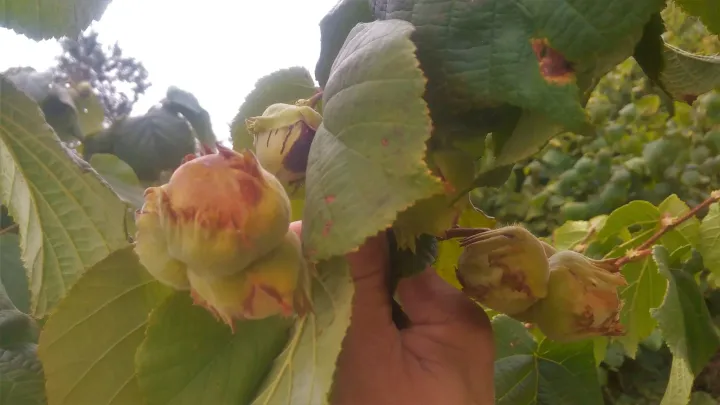
Description
Sowing dates
Planting hybrids of American and common hazel is usually carried out vegetatively: by layering, root division, or grafting. Spring planting in northern regions is conducted in April, before the active sap flow, allowing saplings to root before the heat sets in.
Autumn planting is considered more favorable in regions with mild climates, as it allows the plant to adapt to the soil over the autumn period and resume vegetation as soon as the first warm spring temperatures arrive.
For establishing commercial orchards, saplings are planted in a 5x5 or 6x6 meter pattern. This density ensures sufficient nutrient area and crown light exposure for the formation of a full nut harvest in the future.
When choosing planting material, it is important to prioritize regionalized varieties obtained through breeding by crossing the frost-resistant American hazel and the large-fruited common hazel.
An essential preparation step is applying organic fertilizers directly into the planting hole, which creates a favorable start for the development of the young plant's root system in the first two years after planting.
Growing requirements
The hybrids belong to the Betulaceae family and are distinguished by high ecological plasticity. They successfully combine the cold hardiness of the American species with the high productivity and quality of the European hazelnut.
Optimal soils for this crop are light, fertile loams with a neutral or slightly acidic reaction. The plants are extremely sensitive to moisture stagnation; therefore, drainage systems must be installed in areas with high groundwater levels.
Climatic requirements include providing moderate moisture throughout the growing season. The hybrids are capable of withstanding winter frosts down to -30°C, making them promising for cultivation in temperate and northern regions.
For normal development and nut setting, a sunny location is necessary. In the shade, the crown becomes sparse and bush productivity drops significantly, so the chosen site must exclude shading by tall trees or buildings.
Maintenance of the plantations includes systematic loosening of the near-trunk circles and soil mulching. Mulch helps maintain the required moisture level and suppresses weed growth, preventing the development of surface roots.
Yield
Hybrids begin to produce their first commercial yield 3–4 years after planting, but full-scale fruiting usually occurs between 7 and 10 years of age. A mature, properly pruned bush can produce up to 5–8 kilograms of high-quality nuts per season.
Bearing periodicity is poorly expressed, which is an advantage of these hybrids compared to wild forms. Stability of the harvest depends on annual sanitary and crown-forming pruning.
The economic use of the harvest is universal: the nuts are suitable for fresh consumption as well as for processing in the food industry. The high fat content and valuable micronutrients make them a sought-after raw material.
Nut quality is determined by the correct choice of pollinators, as most hybrids require the presence of other hazel varieties nearby for cross-pollination, ensuring full kernel formation inside the shell.
Harvesting is carried out as the husks of the nuts mature. It is important not to let the fruit over-ripen on the branches to avoid pest damage and nut spoilage during periods of high air humidity.
Main diseases and pests
The main pest is the nut weevil, which lays eggs in developing ovaries. Affected nuts fall prematurely, which significantly reduces the total yield of the plantation.
Dangerous diseases include powdery mildew, which affects leaves and young shoots during high air humidity. It appears as a white coating that darkens over time and leads to leaf deformation.
Bacterial blight can affect branches and bark, causing necrosis. To combat this infection, it is necessary to promptly remove and burn the affected plant parts, as well as treat cuts with copper-based preparations.
To prevent the spread of pests, it is recommended to conduct preventive insecticide spraying during the mass flight period of beetles. Also, an effective method is regular cleaning of the site from fallen leaves, where fungal spores can overwinter.
- Nut weevil
- Powdery mildew
- Bacterial blight
- Big bud mite