
Siberian hazel
Corylus heterophylla Fisch. ex Trautv.
Description
Sowing dates
Siberian hazel, belonging to the Betulaceae family, is propagated mainly by vegetative methods or seeds. Seeds (nuts) are sown in the autumn in prepared soil so that they undergo natural stratification during the winter period.
For vegetative propagation, layering or bush division is used, which are planted in their permanent location in early spring or early autumn. It is important to ensure sufficient soil moisture during the seedling establishment period.
The planting pattern for commercial plantations is usually 4 by 3 or 5 by 4 meters, which ensures optimal crown lighting for the formation of a full-fledged crop.
Selecting a plot for plantation establishment requires protection from prevailing cold winds, as early flowering can be affected by late spring frosts.
Planting holes are prepared in advance, enriching them with organic fertilizers, such as humus or compost, to create a nutrient-rich environment for the first years of growth.
Growing requirements
This crop is extremely frost-resistant and adapted to the harsh climatic conditions of the Russian Far East, Korea, and Japan, where it grows in the wild.
It prefers deep, fertile loamy soils with a neutral or slightly acidic reaction, which retain moisture well but do not suffer from stagnant groundwater.
The plant is light-loving, but in its youth, it can tolerate light shading; full sunlight is critical for abundant fruit-bearing of adult bushes.
The requirement for air and soil humidity makes the Siberian hazel dependent on regular watering during dry summer periods, especially in the fruit filling phase.
Regular pruning and bush formation help to maintain the sanitary condition of the plant, improving crown ventilation and preventing excessive thickening.
Yield
The yield of the Siberian hazel depends heavily on pollination conditions, as it is a cross-pollinating plant that requires the presence of several pollinator varieties nearby.
In natural conditions and with proper agricultural technology, fruiting begins 5–7 years after planting, reaching peak productivity at 15–20 years of the plant's life.
The nuts have high nutritional value, contain up to 60% fat and a large amount of vegetable protein, making them highly sought after in the food industry.
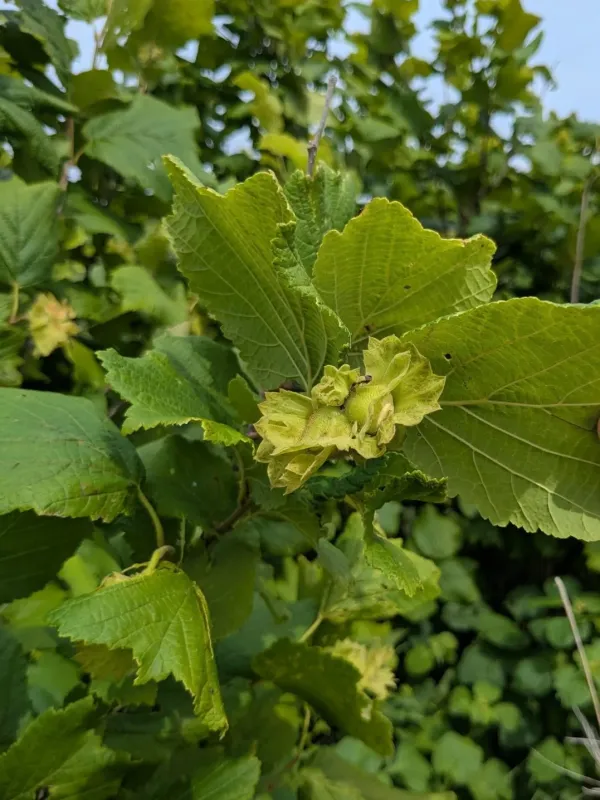
Fruits are collected in clusters of 2–3 pieces, they are completely surrounded by a leafy involucre, which easily separates from the nut shell when ripe.
Stable harvest collection is ensured by the application of complex mineral fertilizers containing nitrogen, phosphorus, and potassium, especially during flowering and fruit growth periods.
Main diseases and pests
Typical pests are the nut weevil, whose larvae are capable of destroying a significant part of the crop by feeding on the nut kernel from the inside.
In conditions of high humidity, hazel can be affected by powdery mildew, which manifests as a white coating on leaves, disrupting the photosynthesis process.
Bud mite infestation is also encountered, leading to deformation of buds and a decrease in the overall flowering potential of the bush in the following season.
Preventive measures include timely sanitary pruning and burning fallen leaves, where fungal spores and pests can hibernate.
In case of mass spread of pests, authorized insecticides and fungicides are used, with treatments carried out before the active flowering period and after harvesting.
Harvesting
Harvesting is carried out in August or September when the fruit involucre begins to turn yellow and the nut itself acquires a characteristic brown color for the variety.
Fruits are harvested manually or by shaking onto cloths spread under the bushes to avoid contamination and damage to the nuts upon contact with the ground.
After harvesting, the nuts must be thoroughly dried in a well-ventilated room or under a canopy for several weeks until a moisture content of 10-12% is reached.
Proper drying prevents mold development during long-term storage, ensuring the preservation of high taste qualities and the marketable appearance of the products.
Nuts cleaned from the involucre are stored in dry, cool places with good ventilation, excluding access by rodents and exposure to direct sunlight.