
Gibbaeum heathii
Gibbaeum heathii
Description
Growing requirements
Gibbaeum heathii is a fascinating succulent perennial belonging to the Aizoaceae family. Native to the arid regions of the Western Cape in South Africa, it has evolved to thrive in harsh, rocky environments with very limited rainfall, making it a highly specialized plant adapted to extreme conditions.
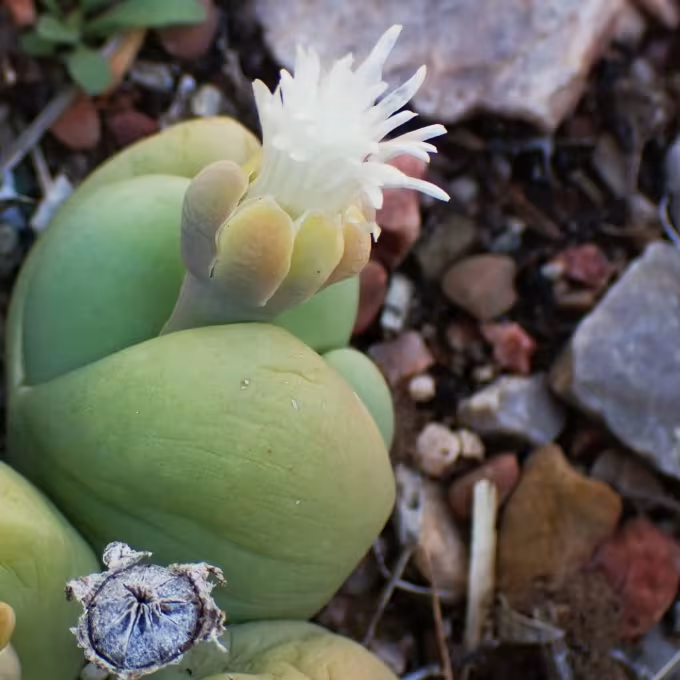
Botanically, this species is categorized as a "living stone" due to its morphology. It consists of a pair of fused, succulent leaves that form a rounded, globular body. This shape is a structural adaptation to conserve internal water reserves and reduce the surface area exposed to the scorching sun, which would otherwise lead to excessive transpiration.
Cultivation requires conditions that closely mimic its natural habitat. The plant demands direct, intense sunlight to maintain its compact, spherical form. If light levels are insufficient, the plant will become etiolated, losing its characteristic aesthetic appeal and weakening its biological structure over time.
The growing medium must be exceptionally well-draining, consisting primarily of coarse sand, perlite, or fine gravel with minimal organic matter. A traditional potting mix with high peat content is unsuitable and will lead to rapid root decay, as the species is accustomed to nutrient-poor, mineral-heavy soils.
Managing the watering schedule is the most critical aspect of care. During the growing season, water should be provided sparingly and only when the substrate is completely dry. During the winter dormancy period, the plant should be kept entirely dry to prevent physiological stress and mimic the natural dry season of its origin.
Main diseases and pests
The most significant threat to Gibbaeum heathii is overwatering, which quickly causes the internal tissues to rot. Once the plant begins to soften due to excessive moisture, it becomes highly susceptible to rapid fungal decomposition that can destroy the specimen within a few days.
Mealybugs represent a common pest threat, often seeking shelter within the central cleft of the leaves. These insects feed on the plant's sap and can go unnoticed until they have caused significant damage. Regular inspection of the cleft area is essential for early detection and manual control using alcohol-dipped swabs.
Spider mites can colonize the plant if the environment is kept too hot and stagnant. These microscopic pests puncture the succulent's skin, leading to unsightly scarring. Maintaining proper airflow and occasionally misting the surrounding environment (without getting the plant itself wet) can help deter their population growth.
Root-knot nematodes are a serious soil-borne threat that can inhibit the plant's nutrient uptake. If a specimen appears stunted or wrinkled despite adequate care, the root system should be inspected. Any damaged roots must be carefully pruned, and the plant should be repotted into sterilized, mineral-based soil.
Fungal infections, often manifested as dark necrotic spots on the epidermis, are a direct result of high humidity levels and poor ventilation. Keeping the plant in a dry, well-ventilated area is the most effective preventative measure to ensure long-term health and structural integrity.