
Fimbristylis dipsacea
Fimbristylis dipsacea
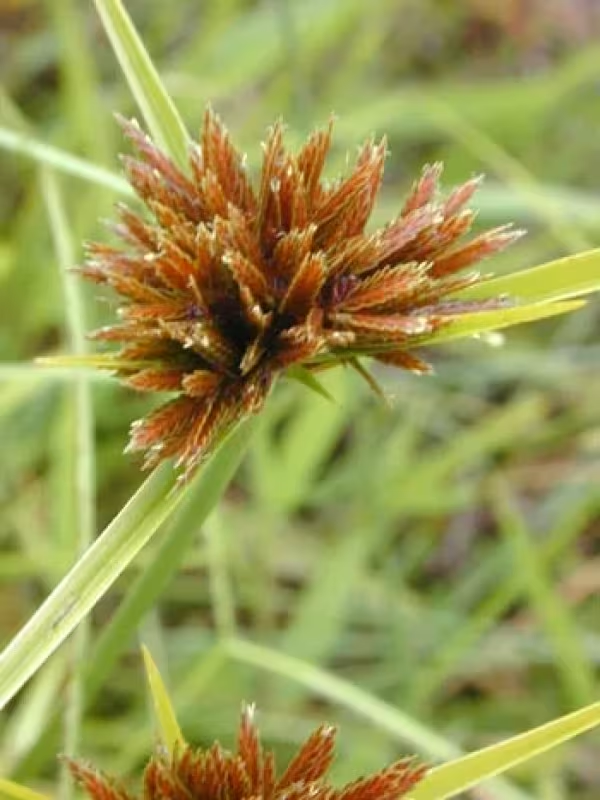
Description
Sowing dates
Fimbristylis dipsacea is primarily an annual plant whose life cycle is deeply dependent on the hydrothermal conditions of its region. In nature, seeds germinate after the floodwaters recede, when the soil is well-warmed and sufficiently moist.
For agronomic use, seeds should be sown in early spring once soil temperatures reach stable levels above 15 degrees Celsius. It is crucial to ensure good contact between the seeds and the moist substrate, as the tiny seeds possess low germination energy if they dry out.
A row-seeding method with 15–20 cm spacing is recommended to provide young seedlings with optimal sunlight access. Seeding rates should be adjusted based on the expected field emergence rates under optimal soil moisture conditions.
Special attention must be paid to seedbed preparation: the soil should be thoroughly leveled and lightly compacted. Shallow seeding (no deeper than 1 cm) is key to achieving uniform seedling emergence in field conditions.
In natural habitats, Fimbristylis often regenerates via self-seeding, making it a promising candidate for the restoration of forage areas in floodplain meadows and marshy lands.
Growing requirements
This species belongs to the Cyperaceae family and has high water requirements. It is a typical hygrophyte that thrives best in areas with excessive moisture or periodic flooding, making it ideal for wetland management.
The optimal soils for this crop include silty, sandy-silty, or well-humified alluvial soils. The plant is tolerant to temporary oxygen deficiency in the root zone, an adaptation supported by the presence of aerenchyma in its tissues.
The temperature optimum for vegetative growth ranges between 20 and 28 degrees Celsius. The crop is sensitive to sudden late frosts, which can entirely destroy populations in the early stages of development.
The plant is light-demanding; therefore, avoiding overcrowding or shading by woody species is recommended. Under conditions of insufficient light, the productivity of its vegetative mass decreases significantly.
It responds positively to the application of easily accessible nitrogen fertilizers, though excessive mineral salt accumulation may inhibit the development of specific rhizospheric microflora essential for this species.
Yield
The economic use of Fimbristylis dipsacea is primarily associated with its ability to produce significant biomass in waterlogged soils where traditional cereal crops would fail to grow or survive.
Green mass yield is strongly correlated with moisture availability during the flowering phase. With adequate nutrition and moisture, yields can reach moderate levels comparable to native wild sedges.
Practical applications include harvesting for hay, often in mixtures with other hydrophilic plants. The nutritional value of Fimbristylis is at its peak before the stems begin to lignify and harden.
The plant is also used in land reclamation projects as a component for stabilizing the banks of drainage canals and reservoirs, serving both protective and soil-binding functions.
The biological seed productivity of the plant is also of interest for ecological restoration, as it demonstrates high seed yield under favorable summer weather conditions.
Main diseases and pests
Fimbristylis dipsacea possesses high natural resistance to fungal diseases due to the specific conditions of its habitat. However, stagnant water combined with high humidity can occasionally trigger outbreaks of rust fungi.
The main pests include phytophagous insects common in wetland ecosystems. Larvae that feed on the roots of sedge-like plants can cause localized damage during the early growth stages.
When cultivated on drained peatlands, the crop may become susceptible to pests common in adjacent agricultural fields if spatial isolation is not strictly maintained.
Weed competition poses the greatest threat during the first month post-sowing. The slow initial growth rate of the plant makes it vulnerable to competition from aggressive grasses and broadleaf weeds.
For pest and disease management, strict crop rotation and regular monitoring of the field are recommended, while avoiding the use of harsh chemical pesticides near sensitive water sources.