
California fagonia
Fagonia californica
Description
Growing requirements
California fagonia (Fagonia californica) is a perennial subshrub belonging to the Zygophyllaceae family. It is a highly specialized plant that exhibits extreme adaptations to arid desert environments.
Native to the southwestern United States and northwestern Mexico, specifically the Sonoran and Mojave deserts, this species thrives in regions with very low annual precipitation and intense sunlight exposure throughout the year.
The cultivation requirements focus on extremely well-draining, rocky, or sandy substrates. In its natural habitat, the plant prospers in poor, alkaline soils where nutrient competition from other flora is minimal.
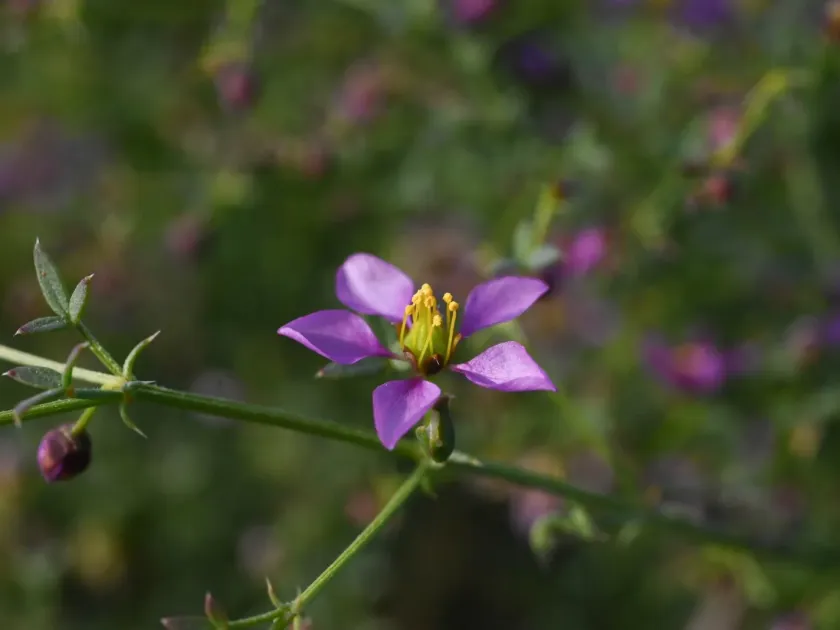
Morphologically, the plant features rigid, thorny stems and small, often simple leaves designed to minimize water loss. Its growth habit is prostrate or spreading, forming low mounds that protect the soil underneath from excessive erosion.
The biological success of Fagonia californica depends on high thermal amplitude and low humidity. It is considered an obligate xerophyte, meaning it cannot tolerate stagnant moisture or high humidity levels, which would lead to immediate root rot.