
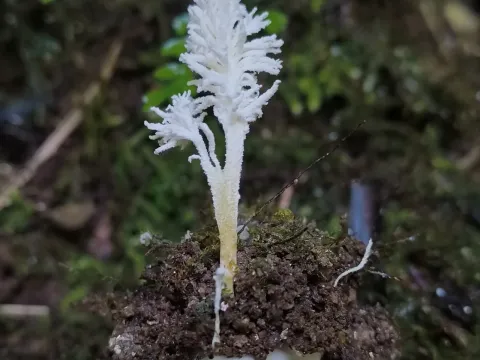
Cordyceps
Cordyceps (Fr.) Link
Cordyceps belongs to the Clavicipitaceae family and requires highly sterile laboratory environments for initial inoculation due to its delicate nature.
What the section contains


Cordyceps
The primary inoculum consists of a pure mycelial culture introduced onto a sterilized grain-based substrate, such as rice or millet, using autoclaving.
Mycelial colonization of the substrate occurs in an incubator over a period of 15 to 30 days, depending on the specific strain's growth rate.
Once the substrate is fully colonized, the blocks are transferred to a climate-controlled room to initiate the development of fruiting bodies, known as stromata.
Maintaining a strict aseptic environment during the sowing process is crucial to prevent contamination from competing mold species or bacteria.
Cordyceps demands high humidity levels, typically between 70% and 90%, to facilitate the active growth and elongation of the fruiting bodies.
Temperature control is vital: the incubation phase requires 20–22 degrees Celsius, while the fruiting phase requires a drop to 16–18 degrees Celsius.
Light is a critical growth factor, as exposure to daily cycles of light stimulates the production of characteristic orange pigments and proper development.
The substrate composition must be rich in nitrogen and carbon sources to support the production of secondary metabolites like cordycepin.
Efficient ventilation systems are essential to maintain oxygen levels and remove excess CO2, which would otherwise inhibit the maturation of the fungi.
The yield of Cordyceps is determined by the purity of the culture, the nutrient density of the substrate, and the stability of the climatic parameters.
Under optimal industrial conditions, growers can achieve significant biomass production per unit of substrate used in the incubation chambers.
The harvest cycle usually lasts about two months from inoculation, at which point the stromata reach their maximum biomass potential.
High-density shelf systems and precise climate monitoring allow for increased productivity and consistent quality throughout the year.
Success in production depends on managing the delicate balance between nutrient availability and environmental stress factors during the development phase.
The most significant threats to Cordyceps crops are common molds such as Penicillium and Aspergillus, which quickly colonize nutrient-rich substrates.
Bacterial infections, often characterized by foul odors and softening of the tissue, can destroy entire batches if sanitation is compromised.
Fungus gnats are major pests that can physically damage the stromata and serve as vectors for various fungal and bacterial pathogens.
Improper airflow or cooling failures can lead to substrate souring, creating an environment unsuitable for Cordyceps growth.
- Implementing strict facility biosecurity protocols
- Utilizing advanced HEPA air filtration systems
- Ensuring rigorous equipment and surface sterilization
Harvesting Cordyceps is a manual process that requires precision to preserve the fragile structure of the orange fruiting bodies.
The stromata are harvested at the peak of their maturation, right before they begin releasing spores, to ensure maximum concentration of bioactive compounds.
Post-harvest, the product is immediately cleaned and subjected to low-temperature dehydration to prevent enzymatic degradation.
Proper drying is essential to reach a moisture content that ensures long-term storage stability without the need for chemical preservatives.
The final dried product is stored in airtight containers away from light and moisture to maintain its pharmacological potency for up to two years.