
White jute
Corchorus capsularis L.
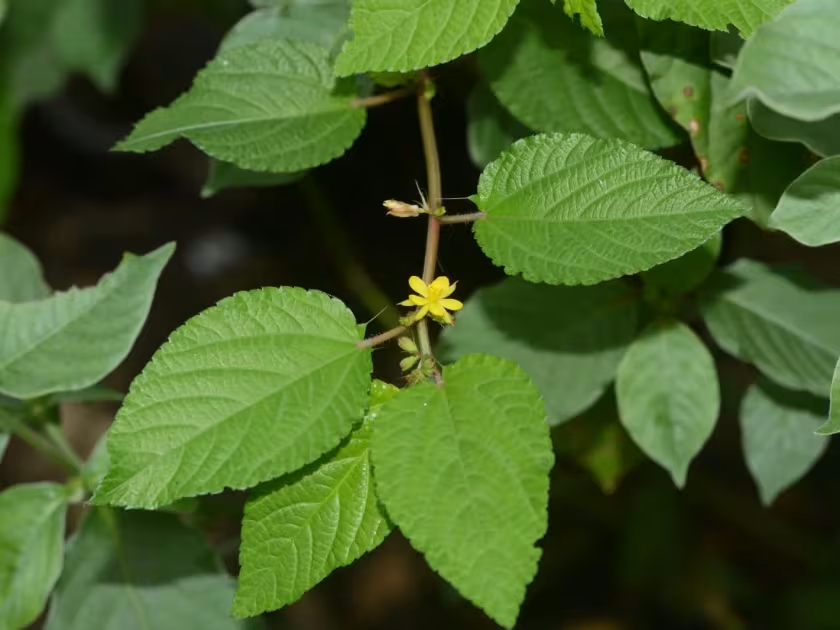
Description
Sowing dates
White jute (Corchorus capsularis L.) is a prominent annual herbaceous plant belonging to the Malvaceae family. It is a warm-season crop that requires specific environmental conditions for optimal growth.
Sowing should begin only when the soil temperature consistently reaches 18–20°C (64–68°F), ensuring rapid germination and uniform establishment of the crop seedlings.
The seeds are typically sown in rows with a spacing of 15–20 cm. Maintaining high planting density is crucial to discourage branching, as non-branched, straight stems produce the highest quality long fibers.
Preparation of the seedbed involves fine plowing to ensure a level surface, as the seeds are small and sensitive to planting depth. Shallow sowing covered with a thin layer of soil is recommended.
In regions with distinct monsoon seasons, sowing is synchronized with the onset of rains to ensure sufficient moisture for the early growth stages of the plant.
Growing requirements
White jute is a hygrophilous plant, thriving in humid, tropical, or subtropical climates where rainfall is abundant and evenly distributed throughout the growing season.
The ideal soil for cultivation is fertile, well-draining loamy or alluvial soil. It is particularly well-suited to the river basins where nutrient-rich silt is deposited annually.
Temperature is a key limiting factor; the plant thrives within a range of 25–35°C. It is highly sensitive to cold, and growth slows significantly if temperatures drop below 15°C.
Although it requires much water, waterlogging should be avoided after the initial growth stages, as it can encourage root diseases and hinder the plant's structural development.
As a short-day plant, its development is influenced by photoperiod. This sensitivity helps in regulating the timing of flowering, which is critical for fiber quality.
Yield
The yield of white jute fiber typically ranges from 2 to 3 metric tons per hectare under ideal growing conditions, including adequate fertilization and moisture management.
Fiber recovery accounts for approximately 5–7% of the total dry biomass of the plant stems. Well-managed crops can reach heights of 3.5 to 4 meters, maximizing the harvestable stem length.
Nitrogen fertilization is essential for maximizing biomass production, though it must be balanced to prevent excessive lodging of the tall stems during high winds.
Strategic harvesting timing is the most important factor in determining final yield quality. Early or delayed harvests result in significant changes to the fiber's texture and strength.
Advanced agricultural practices, such as precision irrigation and the use of high-yielding hybrid seeds, have allowed modern farmers to improve fiber consistency and yield per hectare.
Main diseases and pests
Stem rot, caused by various fungal pathogens like Macrophomina phaseolina, is the most common and damaging disease, particularly in high-humidity conditions.
Anthracnose can also significantly impact production by causing lesions on leaves and stems, leading to defoliation and a reduction in the plant's photosynthetic capacity.
Pests such as the jute leaf beetle and hairy caterpillars are notorious for consuming leaves, which stunts the plant's growth and drastically reduces the final fiber quality.
Root-knot nematodes often pose a hidden threat, weakening the plant's root system and making the entire crop more susceptible to environmental stresses.
Integrated pest management, including crop rotation with non-host species and the use of resistant varieties, is essential to mitigate these biological threats sustainably.
Harvesting
The optimal harvest window is during the full flowering stage. Harvesting at this specific time ensures that the fiber is strong, white, and of high tensile strength.
If harvesting is delayed until the pods form, the fiber quality declines, becoming coarser and darker, which significantly reduces its commercial value.
Stems are cut manually at the base using sickles or with mechanical mowers. They are then bundled and left on the field for a few days to facilitate the shedding of leaves.
The retting process is the primary method of fiber extraction, where bundles are submerged in slow-moving water to allow microbes to separate the fibers from the stem bark.
Post-retting, the fibers are washed, excess water is squeezed out, and they are dried in the sun before being sorted and graded for the global textile market.