
Bufonia tenuifolia
Bufonia tenuifolia
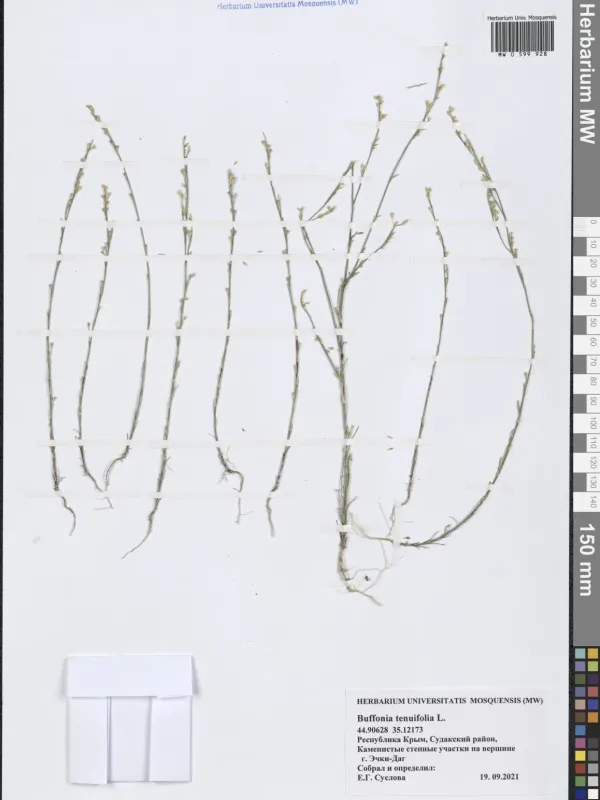
Description
Growing requirements
Bufonia tenuifolia is a perennial herbaceous plant belonging to the Caryophyllaceae family. It is native to arid regions, primarily inhabiting rocky slopes and limestone-rich terrains across the Mediterranean Basin, where it shows remarkable adaptation to harsh environmental conditions.
Botanically, the plant is characterized by slender, branched stems and fine, needle-like leaves, contributing to its delicate appearance. It develops a strong, deep taproot system, which serves as a critical mechanism for surviving in nutrient-poor and dry soils.
The agronomic requirements for this species are centered on excellent drainage. It thrives best in alkaline or neutral substrates that prevent waterlogging, as the root system is highly susceptible to rot if exposed to prolonged moisture during dormant periods.
Climate-wise, Bufonia tenuifolia requires significant sun exposure and prefers warm, dry environments. Its high tolerance to drought makes it a candidate for low-maintenance landscaping and land restoration projects, where it can provide soil cover in otherwise inhospitable areas.
The practical application of this crop lies in its potential for phytostabilization. By colonizing dry, degraded lands, the plant acts as a pioneer species that stabilizes the topsoil, helping to mitigate wind and water erosion in sensitive agricultural or natural zones.