
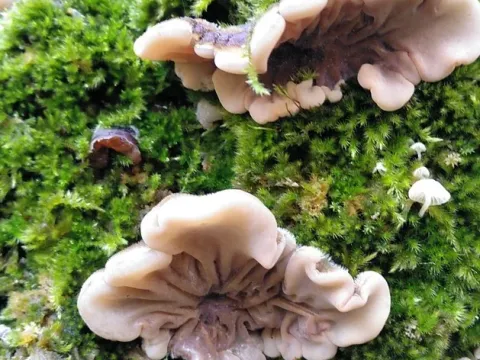
Auricularia
Auricularia
Auricularia, commonly known as wood ear mushrooms, belongs to the Auriculariaceae family. Commercial cultivation primarily involves inoculating specialized substrate blocks with spawn under strictly controlled conditions.
What the section contains
 Auricularia cornea
 Ehrenb.
Auricularia cornea
Auricularia cornea Ehrenb.
 Auricularia nigricans
 (Sw.) Birkebak, Looney & Sánchez-García
Auricularia nigricans
Auricularia nigricans (Sw.) Birkebak, Looney & Sánchez-García
 Auricularia polytricha
 (Mont.) Sacc.
Auricularia polytricha
Auricularia polytricha (Mont.) Sacc.
 Black wood ear
Auricularia heimuer F.Wu, B.K. Cui & Y.C. Dai
Black wood ear
Auricularia heimuer F.Wu, B.K. Cui & Y.C. Dai
 Wood ear mushroom
Auricularia auricula-judae (Fr.) Quél.
Wood ear mushroom
Auricularia auricula-judae (Fr.) Quél.
Auricularia
The substrate typically consists of hardwood sawdust, straw, or other agricultural by-products mixed with supplements to provide necessary nitrogen and minerals for mycelium growth.
The substrate is sterilized to eliminate competing pathogens before being inoculated with high-quality mushroom spawn in a sterile environment.
Incubation occurs at a temperature of 20–25 degrees Celsius until the mycelium fully colonizes the substrate blocks, which usually takes several weeks.
Ensuring the health and vigor of the spawn is critical for achieving a uniform and productive yield throughout the cultivation cycle.
Auricularia is a wood-decaying fungus that thrives in high-humidity environments, requiring relative humidity levels between 85% and 95% for optimal development.
The temperature during the fruiting phase should be maintained between 18 and 28 degrees Celsius to support consistent and healthy mushroom growth.
Proper ventilation is essential, as the mushrooms are sensitive to high carbon dioxide levels, which can cause stunted growth or deformities in the fruiting bodies.
Indirect light is necessary for the development of the mushrooms' characteristic shape and color, requiring 8 to 10 hours of daily exposure during the fruiting stage.
Maintaining a substrate pH level between 5.5 and 6.5 helps create an ideal environment for the fungus while inhibiting the growth of most common bacterial contaminants.
Yield efficiency in Auricularia cultivation is influenced by the quality of the substrate and the precision of environmental controls, typically yielding 25% to 40% of the substrate's wet weight.
Production is harvested in flushes, with 2 to 3 major harvests per substrate block, depending on the vigor of the strain and the management of growing conditions.
Between flushes, growers allow the blocks to recover by adjusting humidity levels, which helps stimulate the formation of new pinheads.
Optimizing nutrient additions, such as rice bran or wheat bran, can significantly improve the total biological efficiency of the substrate blocks.
Standardized commercial operations use climate-controlled chambers to stabilize yield and ensure consistent availability throughout the year.
Green mold (Trichoderma) is the most significant threat to Auricularia, often appearing during the incubation phase and causing total crop loss if not managed.
Bacterial blotch can affect the fruiting bodies, leading to slimy surfaces and decay, usually caused by poor air circulation and excessive moisture on the mushrooms.
Pests such as sciarid flies and phorid flies are common nuisances that damage mycelium and serve as vectors for various fungal pathogens.
Integrated pest management strategies, including the use of sticky traps and physical barriers like fine mesh screens, are essential for crop protection.
Strict sanitation protocols, including regular room disinfection and quality control of incoming materials, remain the primary defense against disease outbreaks.
Harvesting should occur when the mushrooms reach full size but before the edges begin to lose their structural integrity and crisp texture.
Fruiting bodies are carefully removed at the base to avoid damaging the substrate block, ensuring the surface remains clean for subsequent flushes.
Fresh Auricularia mushrooms have high water content and are traditionally dehydrated shortly after harvesting to prevent spoilage.
Dried wood ear mushrooms are a highly stable product, prized for their ability to rehydrate effectively and maintain a distinct crunchy texture in culinary dishes.
Proper harvesting practices ensure high-quality produce that meets market standards for color, shape, and overall cleanliness.