
Asplundia latifolia
Asplundia latifolia
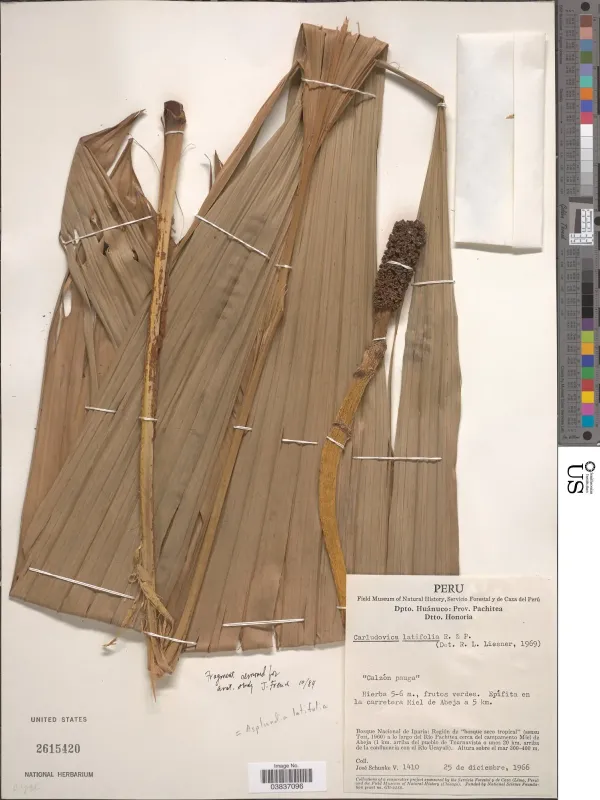
Description
Growing requirements
Asplundia latifolia is a prominent member of the Cyclanthaceae family, known for its significant role in producing plant-based fibers. This perennial plant is native to the tropical rainforests of Central and South America, where it thrives in warm and humid microclimates.
Successful cultivation of this species requires constant temperatures between 22 and 28 degrees Celsius. Humidity levels must remain consistently high, ideally within the 70-80 percent range, to ensure optimal leaf development and fiber quality.
The ideal soil for Asplundia consists of nutrient-rich, humus-heavy substrates that offer excellent drainage. Although the plant loves moisture, it cannot tolerate waterlogged conditions, which lead to rapid root degradation and fungal infections.
In terms of light exposure, the plant is adapted to the filtered light of the forest understory. Direct sunlight can scorch the foliage, so in agricultural plantations, shade management is essential for maintaining the integrity and health of the leaves.
Morphologically, the plant presents as a robust rosette of large, fan-like leaves. Its architectural form allows it to capture and store energy efficiently, contributing to the development of the strong vascular fibers that make it a valuable economic asset.
Harvesting
The harvesting process centers on collecting the immature, unopened leaves. Timing is critical, as only the young, tightly coiled leaves contain the specific fiber characteristics necessary for high-quality weaving materials.
Following harvest, the material undergoes a meticulous process of stripping and cleaning. Workers carefully extract the fiber bundles, which are then bleached or dried under controlled conditions to ensure they remain flexible yet strong enough for commercial use.
The primary industrial application of this plant is the creation of woven goods. This includes traditional basketry, mats, and the iconic Panama hats, which rely on the durability and flexibility of these specific tropical fibers.
Sustainable harvesting techniques are vital for maintaining the populations of Asplundia latifolia. By avoiding over-harvesting and promoting agroforestry systems, producers ensure the long-term viability of this important forest resource.
Future research in the agronomy of Asplundia focuses on scaling production through improved vegetative propagation techniques. This aims to reduce dependency on wild-harvested plants and secure a sustainable supply for global artisanal markets.