

Flower-of-an-hour
Hibiscus trionum
Description
How to tell it apart
Hibiscus trionum, commonly known as flower-of-an-hour, is an annual weed belonging to the Malvaceae family. It is a summer annual that reproduces entirely by seeds.
The plant features a branching stem that can grow from 20 to 80 cm tall. The stems are typically covered with sparse, coarse hairs and can be either erect or spreading.
Its leaves are distinctively palmately divided, with lower leaves often entire and upper leaves showing three to five lobes with serrated margins.
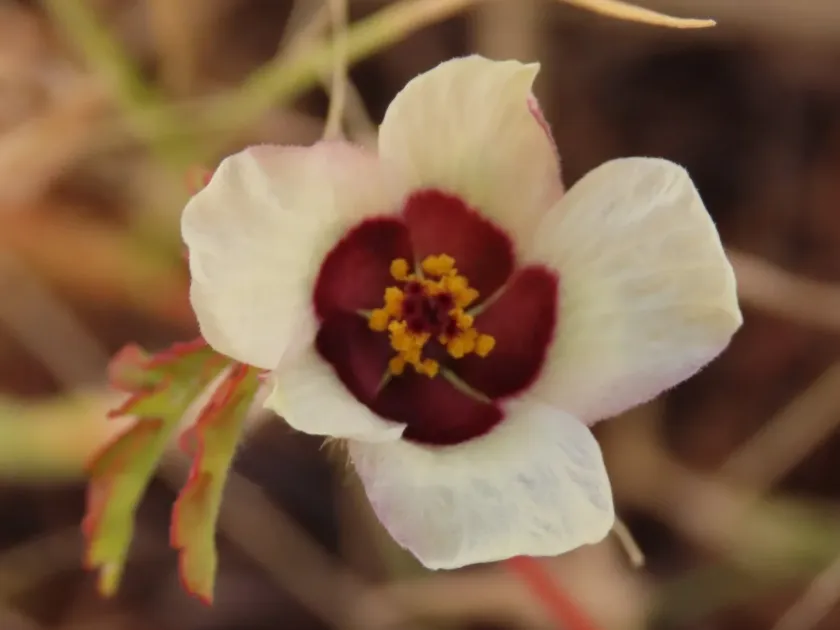
The flowers are large and showy with pale yellow or white petals, each featuring a deep purple or maroon spot at the base. The calyx is inflated, membranous, and prominently veined.
The fruit is a many-seeded capsule enclosed within the inflated calyx. The seeds are kidney-shaped, dark brown or grey, with a rough, warty surface texture.
Where it grows
This species thrives in well-lit areas with fertile, light soils. It frequently invades agricultural fields, vegetable gardens, and disturbed habitats like roadsides.
Hibiscus trionum is particularly problematic in row crops, including corn, sunflowers, sugar beets, and various horticultural vegetable crops.
Thanks to its high adaptability, the weed quickly colonizes vacant spaces in fields following soil cultivation or inadequate weeding practices.
Mass germination typically occurs once soil temperatures reach 10–12°C, allowing it to compete effectively with early-sown summer crops.
Seeds are primarily spread through contaminated irrigation water, manure, or agricultural machinery that has not been properly cleaned between fields.
Harm it causes
The primary damage results from intense competition with crops for essential nutrients, soil moisture, and sunlight during critical growth stages.
The plant's root system can deplete soil moisture levels, which is particularly detrimental in arid regions, directly impacting the final crop yield.
Hibiscus trionum creates a dense canopy that shades out crop seedlings, leading to stunted development and significant reductions in stand density.
As a member of the Malvaceae family, it can act as a host for various diseases and pests that may transfer to economically valuable crops.
Presence of this weed hinders mechanical harvesting operations, potentially causing yield losses and increasing the costs associated with grain cleaning.
How to control
Cultural control methods include deep autumn plowing to bury seeds at depths where germination is inhibited and precise inter-row cultivation during the growing season.
Implementing a diverse crop rotation is essential, utilizing crops that produce a dense canopy to naturally suppress weed growth in the early stages.
Chemical control is highly effective when applying herbicides to which Malvaceae species are sensitive during the seedling or early vegetative growth stages.
Pre-emergence soil-applied herbicides are recommended in corn and sunflower crops to prevent the primary flush of weed seedlings from establishing.
- Timely harrowing of crops to destroy small seedlings.
- Maintaining optimal crop planting densities.
- Using high-quality, certified seed to prevent contamination.
- Managing weed populations in non-crop areas, such as field edges.
Content graph
Connections · Flower-of-an-hour
Most often together:
Marketplace
Products · 5


Concur, KS (metribuzin, 600 g/l)
Белоцерковский завод препаративных форм
Herbicides
0
0
·
45
3 offers
25.96 €per 1 l
Buy


Gerber
Superus Co., Ltd., Китай, Yangzhou Pioneer Chemical Co., Ltd., Китай
Herbicides
0
0
·
1.9K
No offers
—
Details
Biology
Taxonomy
- Latin name
- Hibiscus trionum
- Family
- Однолетние двудольные сорняки