

Description
How to tell it apart
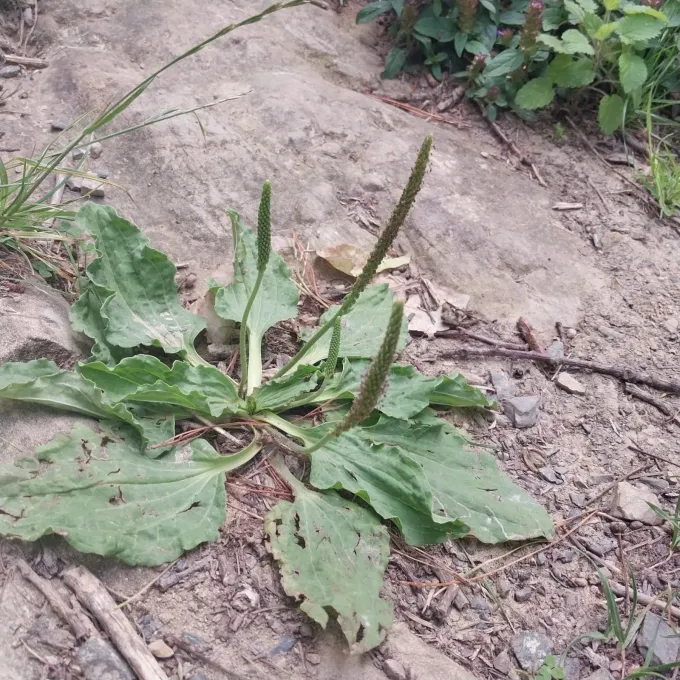
Greater plantain is a perennial herbaceous plant belonging to the Plantaginaceae family. It is characterized by a basal rosette of broad, oval-shaped leaves with distinct parallel venation.
The plant lacks a prominent stem; instead, it develops long, leafless flower spikes. These spikes are densely covered with tiny, inconspicuous flowers that bloom throughout the summer season.
Its root system consists of a short, sturdy rhizome with numerous fine, fibrous roots. This structure allows the plant to anchor itself firmly into compacted soil and withstand significant trampling.
The plant reproduces primarily by seeds, which are small, brown, and produced in large quantities. The seeds are highly durable and can remain viable in the soil for several years, ensuring long-term infestation.
Plantago major is easily identified by its ability to thrive in poor, compacted conditions where other plants might struggle, often colonizing disturbed ground and field edges.
Where it grows
Greater plantain prefers compacted and nutrient-rich soils. It is frequently found along roadsides, footpaths, pastures, and in neglected field areas where soil density is high.
It poses a significant threat in meadows, pastures, and fields with permanent grass cover, as it competes effectively with desirable forage species for space and sunlight.
In arable lands, it is more common in fields with minimal tillage or those that suffer from frequent machinery traffic, which naturally compacts the soil and favors this specific weed.
It can also be found in damp areas of the field, as it is relatively tolerant of wet conditions and can survive temporary waterlogging better than many sensitive crops.
As a highly plastic species, it easily spreads into agricultural landscapes, often hitchhiking through the movement of farm equipment and poorly cleaned grain shipments.
Harm it causes
The primary damage caused by Greater plantain is the competition with crops for essential soil nutrients and water, which ultimately results in diminished yields and reduced plant vigor.
Large leaf rosettes create a ground cover that can interfere with the development of emerging crop seedlings, potentially reducing the overall stand density in the field.
When present in pastures, the weed can displace high-quality grazing grasses, negatively impacting the nutritional intake of livestock and reducing the overall productivity of the grazing area.
Its seeds can contaminate harvested grain, causing economic losses due to the added costs of processing, cleaning, and sorting required to meet quality standards for market.
Greater plantain acts as a host for various agricultural pests and fungal diseases, providing a reservoir where these pathogens can survive and then spread to vulnerable crops.
How to control
Deep plowing remains the most effective mechanical control method, as it disrupts the root system and prevents the weed from regenerating, especially if performed before seed set.
Regular cultivation and inter-row hoeing are essential in row crops to uproot the plants and destroy the leaf rosettes before they have a chance to compete with the main crop.
Chemical control involving systemic herbicides, particularly those targeting broad-leaved weeds like 2,4-D or dicamba, is highly effective when applied to young, actively growing rosettes.
Preventative measures include cleaning farm machinery thoroughly before moving from infested fields to clean areas to prevent the spread of seeds via contaminated mud and debris.
Implementing a diverse crop rotation helps to break the lifecycle of the weed, making it harder for the population to become established and persistent over multiple growing seasons.
Content graph
Connections · Greater plantain
Most often together:
Marketplace
Products · 3


Biology
Taxonomy
- Latin name
- Plantago major
- Family
- Многолетние двудольные