
Hog Fennel
Peucedanum officinale
Description
How to tell it apart
Hog Fennel (Peucedanum officinale) is a member of the Apiaceae family, characterized by its robust perennial growth and a deep, branched taproot system.
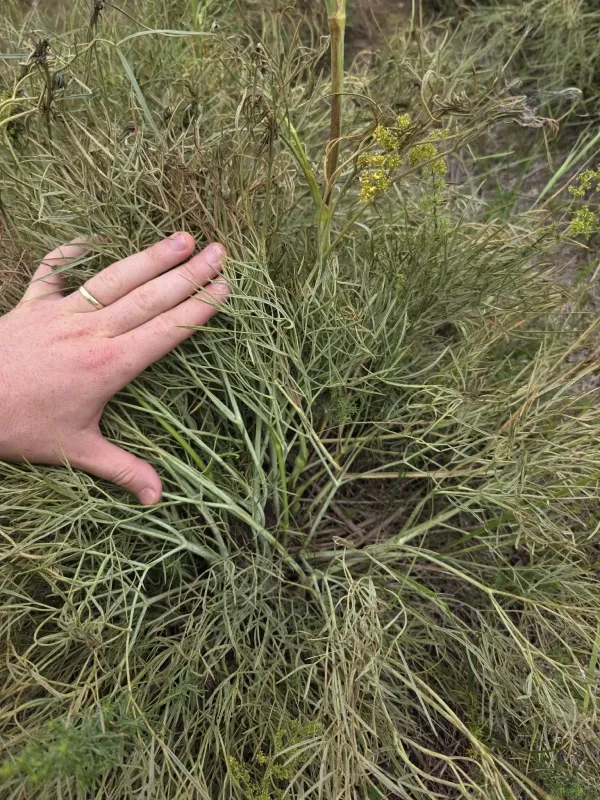
The plant typically grows to a height of 1–1.5 meters, featuring sturdy, ribbed stems and blue-green, finely divided foliage that is stiff to the touch.
During the flowering season in mid-summer, it produces large, complex umbels filled with small yellow flowers, making it easily distinguishable in the field.
Its seeds are flattened with distinct wings, an evolutionary adaptation that facilitates efficient long-distance dispersal via wind currents.
Biologically, it is highly persistent; its ability to regenerate from fragments of its root system makes it particularly challenging to eradicate manually.
Where it grows
This weed thrives in open, sun-exposed environments and is frequently found in meadows, along roadsides, and on saline or moderately moist soils.
In agricultural settings, it is a significant nuisance in pastures and hay fields, as well as in cereal crops that lack frequent soil cultivation.
It often colonizes fallow lands, where its aggressive growth habit allows it to dominate native vegetation before spreading to nearby arable crops.
The plant displays high environmental plasticity, allowing it to survive in both waterlogged conditions and periods of moderate drought.
It prefers undisturbed or minimally managed areas, making it a common sight along field margins and forest edges near cultivated land.
Harm it causes
The primary damage caused by Hog Fennel is its direct competition with crops for essential soil nutrients and water, which often stunts crop growth.
By forming dense stands of thick foliage, the plant creates significant shading, which inhibits the photosynthetic capacity of young crop seedlings.
Its deep root system effectively depletes groundwater reserves, leaving the main crop vulnerable to stress, especially in dry weather conditions.
Contamination of harvested grain with seeds or plant parts of this weed can lead to reduced product quality and increased processing costs for cleaning.
Furthermore, it can host pests and pathogens common to the Apiaceae family, potentially acting as a reservoir for disease spread within the field.
How to control
Deep autumn plowing is the most effective cultural method, as it disrupts the root system and exposes it to frost, reducing the plant's viability.
Systematic mowing or cutting of the aerial parts before the plant sets seeds is crucial to prevent further spread and weaken the persistent rootstocks.
Incorporating a rotation of hoeing crops allows for mechanical inter-row cultivation, which helps keep the weed population under control throughout the season.
Chemical control usually involves the application of glyphosate-based herbicides on fallow ground or post-harvest fields to reach the root systems effectively.
While selective herbicides may be used in growing crops, their effectiveness against established mature perennials is often limited, requiring repeated applications.
Taxonomy
- Latin name
- Peucedanum officinale
- Family
- Зонтичные
- EPPO code
- PCDOF