
Small carrot
Daucus pusillus
Description
How to tell it apart
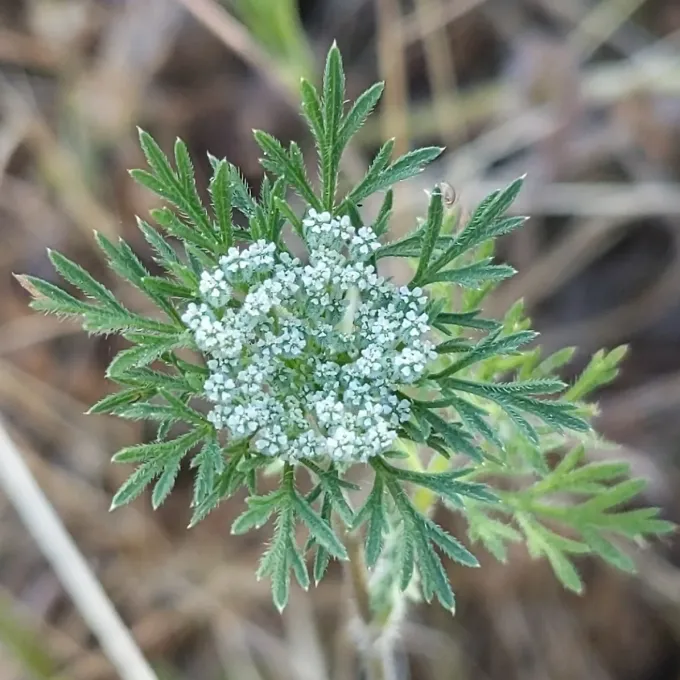
Small carrot (Daucus pusillus) is an annual herbaceous weed belonging to the Apiaceae family. It is typically identified by its small size and upright growth habit, usually reaching a height of 20 to 40 centimeters under optimal conditions.
The stems are characterized by a dense covering of stiff hairs, which serves as a primary morphological feature for distinguishing this species from other related weeds. The leaves are finely dissected and pinnate, resembling the foliage of domestic carrots but significantly smaller.
Small white flowers are arranged in complex umbels, which is typical for the carrot family. The seeds produced by the plant are equipped with small hooked bristles, a mechanism that facilitates dispersal via attachment to animal fur or agricultural machinery.
The plant develops a slender taproot system, which is efficient at accessing water in the upper soil horizons. This adaptation allows it to germinate early in the season, giving it a head start over crop seedlings.
Small carrot exhibits high morphological variability, allowing it to adapt to different light and soil moisture conditions, which makes it a persistent weed in various environments.
Where it grows
The native range of Daucus pusillus is primarily in North America, where it is found across a wide variety of habitats. It thrives in open, disturbed soils, making it common in pastures, roadsides, and abandoned fields.
The weed shows a clear preference for sandy or loamy soils that are well-drained and exposed to full sunlight. It rarely establishes in dense, competitive vegetation, favoring areas where the soil surface is exposed.
In agricultural settings, small carrot often invades small grain fields during the winter or early spring. Its ability to tolerate low-temperature conditions makes it particularly well-adapted to fall-seeded crops.
The spread of this weed is largely facilitated by human activities, including the movement of soil and grain contaminated with seeds. Water erosion is also a factor in spreading seeds to lower-lying areas of fields.
Because it is well-adapted to disturbed ground, it acts as a primary colonizer in fields after heavy rain or tillage events that fail to achieve total weed control.
Harm it causes
The primary agronomic impact of small carrot is its role as a resource competitor in the early growth stages of crops. It rapidly consumes available nitrogen and moisture, hindering the development of the primary crop.
Shading caused by dense patches of the weed can restrict the growth of young crops, leading to thinner stands and overall reduced yields. In pastures, it can crowd out desirable forage grasses, reducing the nutritional quality of the hay or grazing area.
Infection levels are often high enough to necessitate harvest adjustments, as the presence of weed biomass increases the moisture content of the harvested grain and can lead to clogging of mechanical equipment.
The plant acts as a host for various agricultural pests and diseases, potentially bridging the gap for pathogens that infect commercially grown crops in the same family, such as cultivated carrots or parsnips.
- Yield reduction due to resource competition.
- Increased impurity of harvested grain.
- Degradation of pasture quality for livestock.
- Increased operational costs for weed management.
How to control
Integrated weed management is the most effective approach for controlling small carrot. This includes rotation with crops that have different planting times to disrupt the lifecycle of the weed.
Mechanical control through deep tillage is highly effective in the fall or early spring, as it buries the seeds deep enough to prevent emergence. Shallow cultivation between rows in wider-spaced crops is also a standard control practice.
Chemical control involves the use of systemic herbicides applied during the early vegetative phase. Choosing the right herbicide requires considering the tolerance of the primary crop to avoid phytotoxicity.
Field sanitation is critical; controlling small carrot on field borders, ditches, and roadsides prevents the re-infestation of cultivated areas. Regular scouting is necessary to identify and treat early outbreaks before they produce seeds.
By combining cultural, mechanical, and chemical practices, producers can successfully mitigate the competitive pressure exerted by Daucus pusillus on their yields.
Taxonomy
- Latin name
- Daucus pusillus
- Family
- Зонтичные
- EPPO code
- DAUPU