
Longleaf sickleweed
Falcaria vulgaris
Description
How to tell it apart
Longleaf sickleweed (Falcaria vulgaris) is a perennial herbaceous plant belonging to the Apiaceae family. It is characterized by a deep, powerful taproot that allows it to survive in challenging conditions.
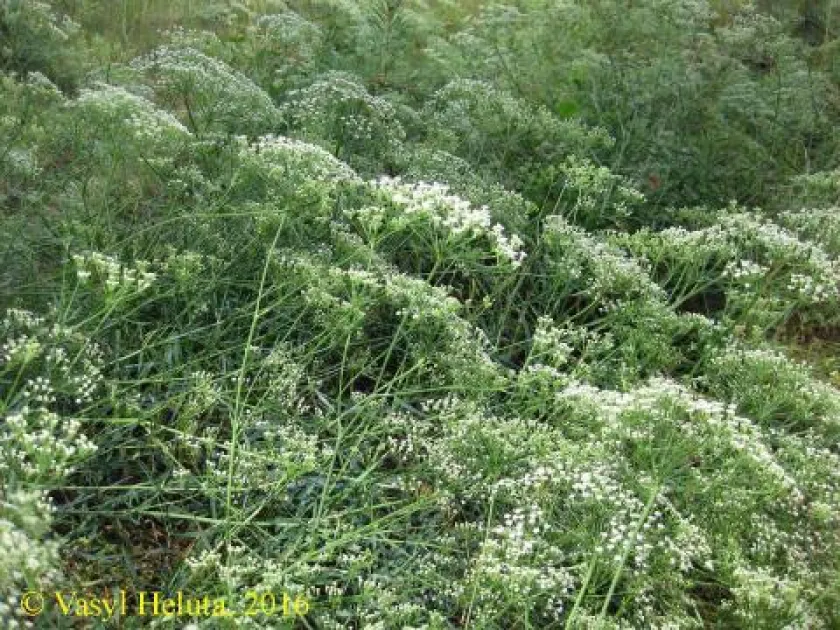
The stem is erect and branched, reaching up to 80 cm in height. The leaves are leathery and rigid, pinnately divided with sharp-toothed margins, which gives the plant a distinct, somewhat prickly appearance.
The inflorescence consists of compound umbels with small white flowers. Blooming typically occurs in mid-summer, followed by the development of elongated seeds that disperse easily.
This weed is a prolific re-sprouter. It reproduces via seeds and vegetatively through its extensive root system, making it highly resilient against mechanical removal.
It can be identified by the characteristic glaucous or bluish-green hue of its foliage and the tough, resilient nature of its leaves throughout the growing season.
Where it grows
Longleaf sickleweed is commonly found in steppe and forest-steppe regions. It thrives in dry, warm soils and is well-adapted to environments with low moisture availability.
In natural settings, it occupies waste areas, dry slopes, roadside banks, and stony ground. It is known for its high drought tolerance and ability to colonize disturbed soil.
In agricultural settings, it frequently infests cereal crops, row crops, and perennial grass fields, often gaining a foothold in fallow lands that are not properly maintained.
The plant quickly claims space in fields where the turf layer is broken or where primary tillage operations were insufficient to reach the deeper root fragments.
Once established, the weed forms dense patches that are difficult to manage and can persist for many years if not treated with appropriate chemical or mechanical methods.
Harm it causes
The primary harm caused by sickleweed is its intense competition for water and nutrients. Its deep roots allow it to extract moisture from deeper soil layers, depriving crops of essential resources.
High infestation levels result in significant yield losses. Furthermore, the stiff, woody stems of the mature plants can interfere with harvesting machinery and increase grain moisture content.
Sickleweed acts as an alternative host for various pests and pathogens that may migrate to nearby agricultural crops, potentially increasing the need for pesticide interventions.
On grazing lands, the presence of this weed reduces forage quality. The rigid, thorny nature of the mature leaves makes it unpalatable for livestock.
Because the root system is regenerative, cultivation often fails to kill the plant completely, as cutting the roots into fragments can actually stimulate new growth.
How to control
Effective control requires a combination of strategies, starting with deep plowing to invert the soil layer and prevent regrowth of root fragments.
Chemical control using systemic herbicides, particularly those based on glyphosate, is most effective during the post-harvest period when the plant is actively translocating nutrients to the roots.
Selective herbicides may be used in cereal crops, though long-term suppression usually requires repeated treatments over several growing seasons.
Cultural practices, such as incorporating cover crops or maintaining a strict crop rotation, help to crowd out the weed and reduce its competitive advantage.
- Deep mechanical tillage.
- Application of systemic herbicides.
- Strategic crop rotation.
- Maintenance of field edges and non-crop areas.
Taxonomy
- Latin name
- Falcaria vulgaris
- Family
- Зонтичные
- EPPO code
- FALVU