
Common hogweed
Heracleum sphondylium
Description
How to tell it apart
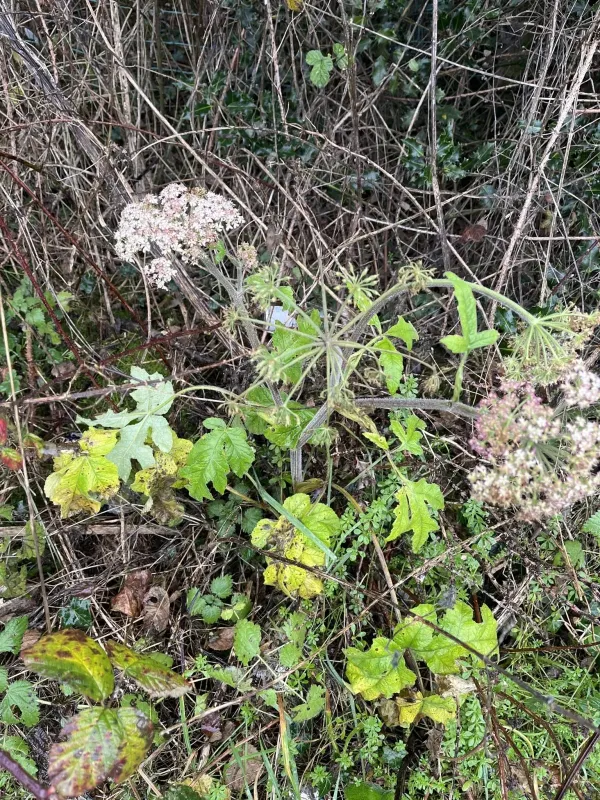
Common hogweed (Heracleum sphondylium) is a perennial or biennial plant belonging to the Apiaceae family, characterized by its thick, hollow, and ribbed stems.
The plant grows up to 1.5 meters in height and features large, compound leaves with distinct hairs, which can sometimes cause irritation to the skin upon contact.
It produces large, flat-topped umbels of white or greenish flowers during the summer months, which are highly attractive to various pollinators including bees and hoverflies.
The root system is a deep taproot that allows the plant to persist in the ground and regrow even after partial mechanical damage to the aerial parts.
Reproduction is solely through seed production, and these seeds are highly dispersive, often carried by wind and water across agricultural landscapes.
Where it grows
The common hogweed is native to Europe and Western Asia, thriving in meadows, damp woodlands, and along field margins where soil moisture is sufficient.
In agricultural settings, it frequently occupies fallow lands, abandoned pastures, and the edges of permanent grassland where competition is low.
It is often found in hayfields where it exploits openings in the crop cover, growing rapidly to outcompete standard forage species for sunlight and nutrients.
The plant favors nitrogen-rich soils, making it particularly persistent in areas that have been previously fertilized or enriched through organic matter accumulation.
It is commonly observed in riparian zones bordering agricultural fields, acting as a secondary source of infestation when seeds are washed into the cultivated area.
Harm it causes
The main harm caused by Heracleum sphondylium is its competitive nature, which results in significant yield loss in perennial forage and grazing crops.
Its rapid growth and dense canopy shade out desirable plant species, which limits the available light for grass establishment and healthy pasture development.
Although less toxic than other hogweed species, the plant is still considered a nuisance in hay as it can contaminate feed, reducing its quality and overall livestock intake.
Heavy infestations of the weed can disrupt the harvesting process, clogging machinery and increasing the labor intensity of field maintenance tasks.
Furthermore, common hogweed may serve as an alternative host for certain plant pests and diseases that can eventually migrate to primary agricultural crops.
How to control
Mechanical control involves deep ploughing or tilling, which destroys the primary taproot and prevents the establishment of new plants from seed banks.
Regular mowing or grazing management during the early spring and summer, before the plant reaches the flowering stage, is critical to prevent seed dispersal.
For sustainable weed management, incorporating a crop rotation that includes intensive mechanical cultivation can help deplete the soil seed bank over several years.
Chemical control utilizing glyphosate-based systemic herbicides is effective when applied during the vegetative growth phase when the plant is actively translocating nutrients.
Selective herbicide applications in pasture settings can help remove the hogweed while preserving beneficial grass species, ensuring the productivity of the grassland remains stable.
Taxonomy
- Latin name
- Heracleum sphondylium
- Family
- Зонтичные
- EPPO code
- HERSP