
Sosnowsky's hogweed
Heracleum sosnowskyi
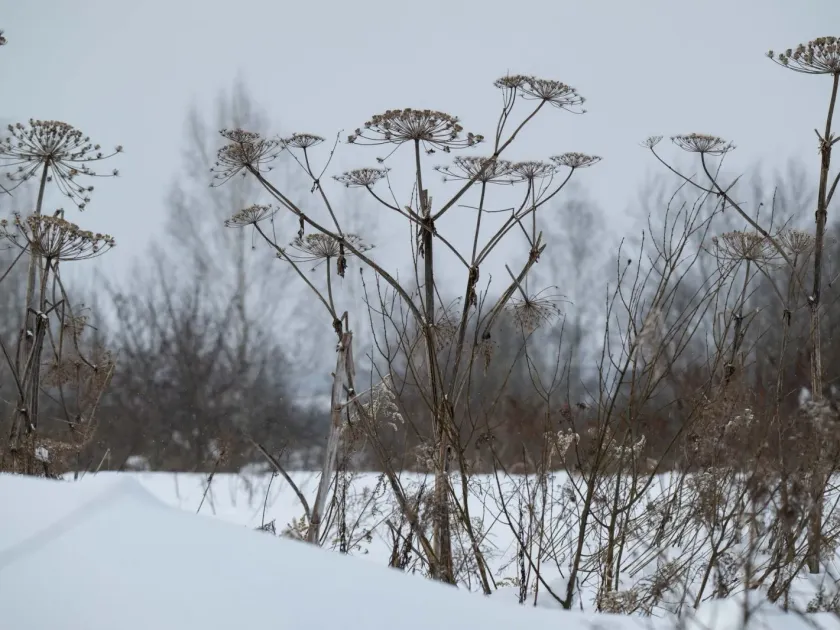
Description
How to tell it apart
Sosnowsky's hogweed (Heracleum sosnowskyi) is a member of the Apiaceae family. It is a perennial herbaceous plant with a massive root system that can extend deep into the soil.
The stem is hollow, ridged, covered with coarse hairs, and often features purple blotches. The leaves are large, compound-pinnate, and can reach lengths of up to 1.5 meters.
The inflorescence consists of large, complex umbels packed with numerous small white flowers. The plant typically blooms from June to July, starting from its second year of life.
The fruit is a dry schizocarp that splits into two mericarps. The plant emits a distinct, strong odor due to its high concentration of essential oils found throughout its tissues.
It is critical to note that all parts of the plant contain furanocoumarins, compounds that cause severe phototoxic skin reactions upon contact with sunlight.
Where it grows
This species is highly invasive and aggressively colonizes abandoned agricultural land, meadows, road verges, and riverbanks.
In the agricultural sector, it poses a major threat to fields, effectively crowding out crops by monopolizing light, space, and moisture resources.
While preferring damp, fertile soils, the plant exhibits remarkable adaptability, allowing it to establish itself in a variety of environments across agricultural landscapes.
It significantly reduces the value of pasture and hay fields, as its presence prevents the growth of nutritious forage and can lead to poisonous feed contamination.
Seeds are dispersed efficiently by wind, water, and agricultural machinery, ensuring rapid spread into neighboring plots and throughout field boundaries.
Harm it causes
The primary agricultural impact is the formation of dense, monoculture stands that render land completely unproductive for farming and livestock.
The plant demonstrates potent allelopathic properties, with root exudates actively suppressing the germination and growth of other plant species in the vicinity.
The plant represents a serious safety hazard for farmers and field workers, as accidental contact with its sap can lead to severe, long-lasting dermatitis and chemical burns.
If harvested with hay or silage, the plant can poison livestock, leading to reduced health, lowered milk quality, and significant economic losses for farmers.
Beyond direct damage, the plant acts as a major barrier to mechanized farming operations, requiring specialized protection for operators and machinery during eradication efforts.
How to control
Agronomic control includes repeated mowing before the flowering stage to deplete the root system's carbohydrate reserves, eventually causing the plant to die.
Deep plowing followed by the planting of competitive, high-density cover crops can effectively suppress re-emergence by depriving new seedlings of sunlight.
Chemical control is achieved through the use of systemic herbicides, primarily glyphosate-based, applied during the active growth phase before seed production.
Sustainable control requires long-term monitoring to eliminate new germinations from the seed bank, which can remain viable in the soil for several years.
- Mechanical removal of the root crown at a depth of 10-15 cm.
- Utilization of selective herbicide tank mixes to improve efficacy.
- Mulching of infested areas to prevent photosynthetic activity.
Taxonomy
- Latin name
- Heracleum sosnowskyi
- Family
- Зонтичные
- EPPO code
- HERSO