
Giant Hogweed
Heracleum mantegazzianum
Description
How to tell it apart
Giant Hogweed (Heracleum mantegazzianum) is a massive herbaceous biennial or perennial plant in the carrot family, Apiaceae. It is notorious for its impressive size, often reaching heights between 2 and 5 meters, which makes it stand out significantly in any landscape.
The stems of the plant are hollow and robust, often measuring up to 10 centimeters in diameter. They are distinctively marked with purple blotches and covered with coarse, stiff white hairs that contribute to the plant's aggressive appearance.
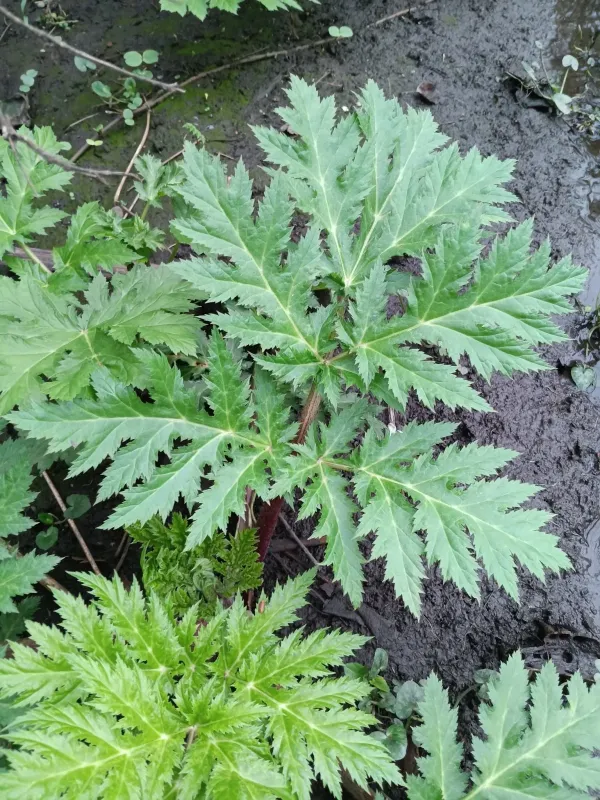
Its leaves are compound, deeply dissected, and can grow over a meter wide. The plant develops huge umbrella-shaped clusters of white flowers, known as umbels, which can reach a diameter of up to 80 centimeters during the peak flowering season.
The root system is thick and tuberous, penetrating deep into the soil. This resilience allows the plant to thrive even after the top part of the vegetation has been cleared or damaged, posing a challenge for eradication.
A single plant is capable of producing an enormous quantity of seeds, sometimes up to 100,000 per season. These seeds are spread by wind, water, and human activity, facilitating rapid invasion into new territories.
Where it grows
Giant Hogweed typically thrives in moist, nutrient-rich soils. It is frequently found along riverbanks, streams, and woodland edges where it can easily establish dense colonies that outcompete native flora.
The plant often colonizes disturbed areas, such as roadsides, railway embankments, and waste grounds. These areas provide the light and moisture necessary for the plant's rapid growth and expansion.
Agricultural landscapes, especially unmanaged pastures and neglected field margins, are also susceptible to infestation. Once established, it can easily spread into adjacent crops, creating a nuisance for farmers and land managers.
It displays remarkable ecological plasticity, allowing it to adapt to diverse environments, including suburban parks and recreational areas. Its ability to colonize these spaces often leads to direct human contact and public health concerns.
The species has spread significantly across Europe and parts of North America, where it continues to expand its range, threatening both urban and rural ecosystems through persistent encroachment.
Harm it causes
The primary hazard of Giant Hogweed is its phototoxic sap. When skin comes into contact with the sap and is subsequently exposed to sunlight, it triggers a severe reaction, resulting in painful blisters and long-term scarring.
Giant Hogweed acts as an invasive species that disrupts local biodiversity. By forming dense monocultures, it shades out native plants and alters the composition of plant communities, leading to long-term ecological degradation.
In an agricultural context, this weed poses significant management challenges. It is difficult to control with standard machinery and creates physical barriers for farming, effectively removing land from productive use.
Furthermore, it acts as a constant seed source for surrounding agricultural fields. Infestations near cultivated land require ongoing monitoring and costly intervention to prevent the spread of seeds into crop rows.
The plant's presence requires land managers to implement strict safety protocols for workers, increasing the costs of maintenance and land preparation due to the risks associated with manual handling and control.
How to control
Controlling Giant Hogweed is a long-term effort that requires a combination of methods. Mechanical control, such as manual excavation of the taproot, is effective for small populations if done before seed production.
For larger infestations, repeated mowing or cutting of the flower heads is crucial to prevent seed dispersal. This process must be repeated consistently over several seasons to exhaust the plant's stored energy in the roots.
Chemical control involving systemic herbicides, such as glyphosate-based products, is highly effective when applied during the active growth phase. Careful application ensures maximum uptake and destruction of the root system.
Safety is paramount during control operations. Personnel must wear fully protective, waterproof gear, including gloves and face shields, to avoid any exposure to the plant's toxic sap, which can cause severe skin irritation.
Integrated management plans, which include soil cultivation and planting competitive ground cover, are the most successful strategies for preventing re-establishment and ensuring the long-term restoration of the affected area.
Taxonomy
- Latin name
- Heracleum mantegazzianum
- Family
- Зонтичные
- EPPO code
- HERMZ