
Culantro
Eryngium foetidum
Description
How to tell it apart
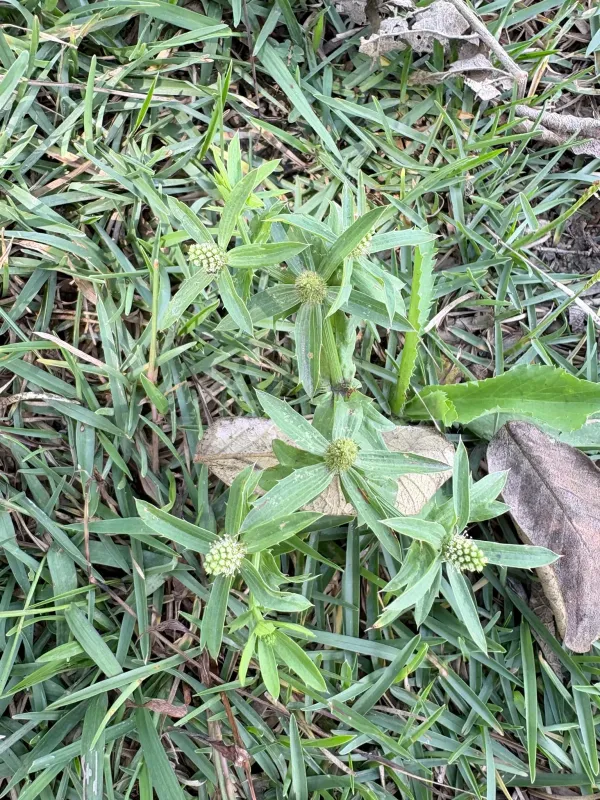
Culantro (Eryngium foetidum) is a herbaceous perennial belonging to the Apiaceae family, easily recognized by its strong, cilantro-like aroma.
The plant features a basal rosette of elongated, serrated leaves that are thick and somewhat leathery in texture.
Its reproductive stems are branched and bear compact, prickly flower heads surrounded by distinct, spine-tipped bracts.
The root system is a robust taproot that allows the plant to persist in varying soil conditions and survive moderate drought.
It is often mistaken for other Eryngium species, but its unique fragrance and specific leaf morphology make identification straightforward.
Where it grows
Native to tropical regions of the Americas, Culantro has become a widespread weed in many tropical and subtropical areas globally.
It thrives in moist, shaded environments, including riverbanks, forest edges, and poorly maintained agricultural fields.
In farming, it is commonly found in vegetable plantations, orchards, and perennial crop systems where irrigation provides constant moisture.
The plant demonstrates high adaptability to degraded soils, frequently colonizing abandoned pastures and construction sites.
It can quickly become established in areas with high traffic, as it is resistant to minor mechanical trampling and physical disturbance.
Harm it causes
As a weed, Culantro competes aggressively with crops for water, space, and essential nutrients, leading to reduced overall yield.
Its presence in pastures is problematic because livestock avoid it due to its strong essential oils and aroma, allowing the weed to displace desirable forage.
The plant's ability to form dense clusters creates a dense canopy at the ground level, shading out smaller vegetable seedlings.
A prolific seed producer, Culantro can quickly saturate the soil seed bank, necessitating long-term management strategies for control.
It acts as a host for certain soil-borne pathogens and pests, potentially increasing the disease pressure on adjacent high-value crops.
How to control
Mechanical control is effective in small areas, provided that the entire taproot is removed to prevent rapid vegetative regrowth.
Deep plowing and tillage operations are essential in large fields to disrupt the root systems and prevent the establishment of new colonies.
Regular mowing prior to the flowering stage is highly recommended to deplete the plant's energy reserves and stop seed dispersal.
Chemical control can be achieved using systemic herbicides; however, the waxy nature of the leaves often requires the addition of surfactants for efficiency.
- Use of organic mulch to physically prevent seed germination and weed growth.
- Implementing crop rotations with vigorous, fast-growing cover crops.
- Cleaning farm equipment thoroughly to prevent the movement of seeds between fields.
Taxonomy
- Latin name
- Eryngium foetidum
- Family
- Зонтичные
- EPPO code
- ERXFO