
Cryptotaenia canadensis
Cryptotaenia canadensis
Description
How to tell it apart
Cryptotaenia canadensis, commonly known as honewort, is a herbaceous perennial plant belonging to the Apiaceae family. It typically grows to a height between 30 and 100 cm.
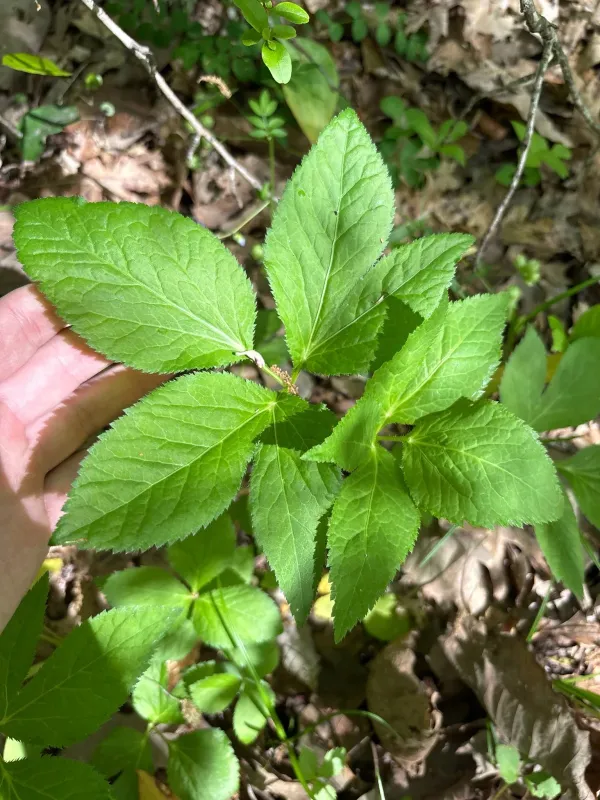
The leaves are trifoliate with long petioles and serrated edges. These features are essential for identifying the plant correctly within an agricultural setting.
It produces small white flowers arranged in irregular, compound umbels, which is a hallmark characteristic of the genus Cryptotaenia.
The stem is smooth and slightly branched towards the top. The root system is quite resilient, allowing the plant to thrive even after mechanical stress.
The seeds are oblong schizocarps that are easily dispersed by wind, water, or farm equipment, making the spread of this weed quite efficient.
Where it grows
Honewort naturally favors moist woodland environments, riverbanks, and shaded areas with rich, organic soil composition.
In agricultural systems, it is often found in moist areas of fields, particularly near woodlots, hedge rows, or where drainage is inadequate.
The plant adapts well to partial shade, which makes it a persistent weed in orchards, berry plantations, and vegetable plots located in humid zones.
Disturbed ground, drainage ditches, and field edges act as reservoirs, allowing the weed to invade adjacent crop rows during the growing season.
Soil compaction and poor water management in fields often exacerbate the occurrence of honewort, as it thrives in consistently damp conditions.
Harm it causes
The primary damage caused by Cryptotaenia canadensis is competition with crops for water, nutrients, and sunlight, leading to decreased biomass and yields.
By forming dense patches, the weed shades out smaller crop seedlings during their critical establishment phase, significantly stunting their growth.
As a member of the Apiaceae family, it can harbor common pests and diseases that affect economically important crops like carrots and celery.
Large colonies of this weed interfere with mechanical harvesting operations, potentially clogging equipment and causing delays in field management.
Persistent infestations are difficult to manage because the plant's seed bank can remain viable in the soil for several years, requiring ongoing monitoring.
How to control
Effective agrotechnical control begins with deep autumn plowing to uproot the plants and disrupt the overwintering root systems before spring.
Regular inter-row cultivation during the early growth stages is crucial for eliminating emerging honewort seedlings before they establish deep roots.
Implementing crop rotation using competitive cover crops can help shade out the weed and limit its ability to spread across the field.
In cases of heavy infestation, pre-plant application of broad-spectrum systemic herbicides is recommended to clear the area before sowing crops.
- Mowing before the flowering stage to prevent seed dispersal.
- Improving field drainage to reduce suitable habitat conditions.
- Using certified weed-free seed for planting to avoid new introductions.
Taxonomy
- Latin name
- Cryptotaenia canadensis
- Family
- Зонтичные
- EPPO code
- CPBCA