
Wild millet
Panicum miliaceum
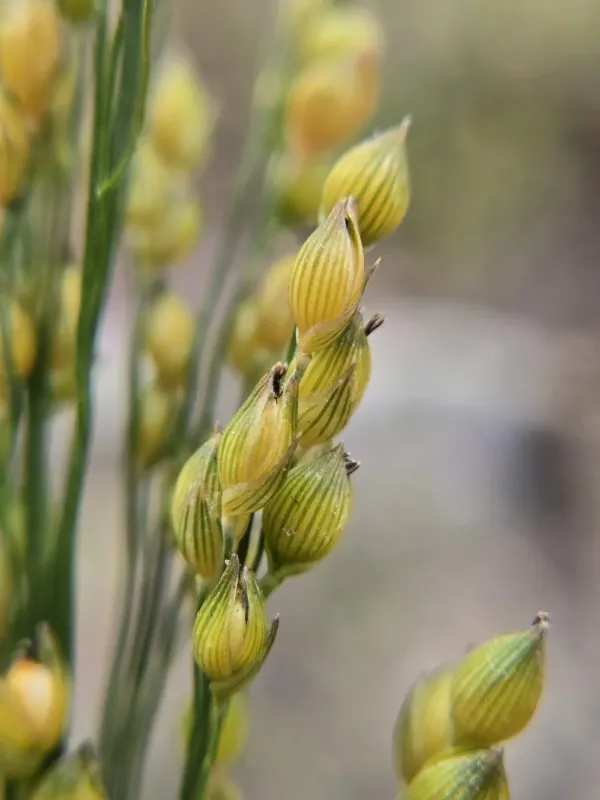
Description
How to tell it apart
Wild millet (Panicum miliaceum) is an annual grass weed belonging to the Poaceae family. It is known for its high adaptability and rapid growth in diverse soil types.
The plant has erect or spreading stems that can reach heights of up to 1 meter. Its leaves are linear and covered with fine hairs, which is a key diagnostic feature for identification.
The inflorescence is a large, loose, and often drooping panicle. This structure allows the plant to produce a vast number of seeds, ensuring its survival and spread.
The root system is fibrous and deep-reaching, providing the plant with excellent drought tolerance and stability in various environmental conditions.
Seedlings emerge in late spring when soil temperatures reach optimal levels, and they develop very quickly, outcompeting many slow-starting crops.
Where it grows
Wild millet is found globally in temperate and subtropical regions. It commonly infests row crops like maize, soybeans, and sunflowers, as well as disturbed areas like field edges.
It prefers fertile, well-drained soils but can survive in a variety of conditions. Its tendency to colonize waste areas makes it a persistent threat to adjacent agricultural fields.
The weed thrives in fields where standard tillage and herbicide programs are inconsistent. It takes advantage of open spaces between crop rows to expand rapidly.
Wild millet is particularly problematic in irrigated areas where moisture is available, allowing it to produce multiple flushes of growth throughout the growing season.
It frequently survives in soil banks for several years, making it a long-term management challenge for farmers who do not practice rotation or effective soil cover.
Harm it causes
The primary damage caused by wild millet is resource competition. It efficiently extracts water and nutrients, leaving significantly less for the primary crop.
By shading the crop during its early development stages, wild millet can cause severe yield reductions. This is particularly noticeable in crops like sugar beet or soybean.
As a host for various agricultural pests and pathogens, wild millet maintains disease cycles on the field, increasing the need for additional pesticide applications.
Contamination of the harvested grain with wild millet seeds is a common issue, leading to quality downgrades and financial losses at processing facilities.
Its ability to shed seeds before the main harvest means that the weed population can increase exponentially if not controlled during the early season.
How to control
Cultural control practices include deep plowing to bury seeds deep enough to prevent emergence, and consistent row cultivation in susceptible crops.
A successful strategy involves creating a stale seedbed by stimulating early weed germination and destroying the emerged seedlings before the crop is sown.
Chemical control focuses on the use of selective graminicides in broadleaf crops. For efficacy, applications should target the young, vegetative stage of the weed.
In maize and other cereal crops, herbicides with specific modes of action are utilized to selectively suppress the weed without harming the primary cultivation.
- Integrated weed management including crop rotation.
- Timely mechanical weeding in row crops.
- Use of certified weed-free seed for planting.
Taxonomy
- Latin name
- Panicum miliaceum
- Family
- Злаковые
- EPPO code
- PANMD