
Nimblewill
Muhlenbergia schreberi
Description
How to tell it apart
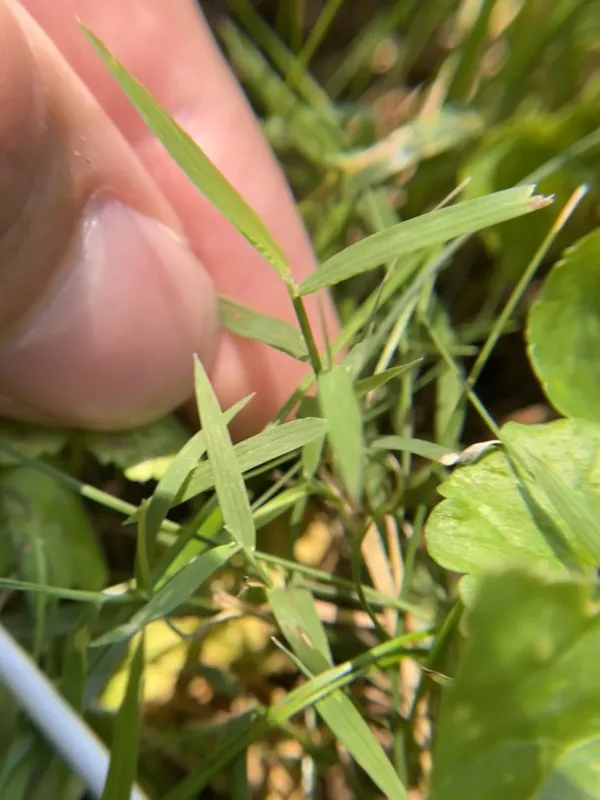
Nimblewill (Muhlenbergia schreberi) is a perennial grass species belonging to the Poaceae family. It is characterized by its sprawling, slender, and branched stems that tend to lie close to the ground, often forming dense mats.
The stems typically reach heights of 20 to 50 cm and are noted for rooting at the lower nodes, which facilitates rapid vegetative spread. The leaves are flat, linear, and have rough margins, providing a distinct texture when touched.
The inflorescence consists of a loose, often nodding panicle containing tiny spikelets. Each spikelet contains a single flower with a long, delicate awn, which is a key diagnostic feature used by agronomists to distinguish this species from similar grasses.
The root system is robust and includes creeping rhizomes that allow the plant to establish itself firmly in the soil. These underground structures are vital for its survival and its ability to re-emerge after mechanical disturbance.
This species exhibits high environmental plasticity, allowing it to thrive in a variety of lighting conditions. It is equally successful in full sun and in shaded areas, such as under the canopy of dense crop stands or woodland edges.
Where it grows
Native to North America, Nimblewill has spread as an invasive weed in many regions with temperate climates. It prefers moist, fertile soils and is frequently found in floodplains, damp meadows, and riparian areas.
In agricultural settings, it poses a significant threat to row crops like corn and soybeans. Its preference for high-fertility, moist soil aligns with ideal growing conditions for major agricultural crops, leading to intense competition.
The weed often colonizes field edges, fence rows, and drainage ditches, acting as a constant source for field encroachment. Its ability to root at the nodes allows it to quickly colonize the open space between crop rows.
In no-till or minimum-tillage farming systems, Nimblewill can become particularly problematic. The lack of soil inversion allows its rhizomes to accumulate in the upper soil layers, leading to rapid population growth over several seasons.
Nimblewill is also a common nuisance in lawns and gardens, where it disrupts the uniformity of turfgrass and outcompetes ornamental plants, requiring persistent and systematic management efforts.
Harm it causes
The primary damage caused by Nimblewill is its aggressive competition with crops for essential nutrients, soil moisture, and sunlight. Its extensive rhizome network depletes soil fertility in the root zones of cultivated plants.
Heavy infestations of Nimblewill significantly reduce crop yields, particularly during the early stages of plant development when the crop is most vulnerable to competition. Dense populations can severely stunt the growth of young crops.
The presence of this weed complicates mechanical field operations. The dense, mat-forming growth can clog cultivation equipment and harvesting machinery, leading to reduced operational efficiency and increased maintenance costs.
Nimblewill serves as a reservoir for various pests and plant diseases. Insects and pathogens that thrive in its dense foliage can easily transition to agricultural crops, thereby increasing the risk of disease outbreaks and pest pressure.
Long-term infestation significantly lowers the economic value of agricultural land. The difficulty of eradicating established perennial rhizomes necessitates high expenditure on chemical and mechanical control measures over many years.
How to control
Mechanical control involves thorough tillage practices. Deep plowing that flips the soil layers helps to cut and desiccate the rhizomes, effectively reducing the plant's capacity to regenerate and spread across the field.
Implementing effective crop rotation is a crucial strategy. Rotating crops with different root structures and competitive abilities helps disrupt the life cycle of the weed and minimizes the build-up of its rhizome population.
Chemical management focuses on systemic herbicides that are absorbed through the leaves and translocated into the rhizomes. Glyphosate-based products are often effective when applied during the period of active plant growth.
In row crops, selective herbicides for grass control can be used, provided they are applied at the correct growth stage to avoid crop injury. Proper calibration of application equipment is essential to ensure maximum efficacy.
- Frequent mowing on field borders to prevent seed production.
- Using high-quality, certified seed to avoid weed contamination.
- Timely inter-row cultivation during the growing season.
- Applying pre-emergence herbicides where management plans allow.
Taxonomy
- Latin name
- Muhlenbergia schreberi
- Family
- Злаковые
- EPPO code
- MUHSC