

Description
How to tell it apart
Stinking chamomile (Anthemis cotula), also known as dog-fennel, is a summer annual weed belonging to the Asteraceae family. It is easily identified by the strong, pungent, and disagreeable odor it emits when crushed.
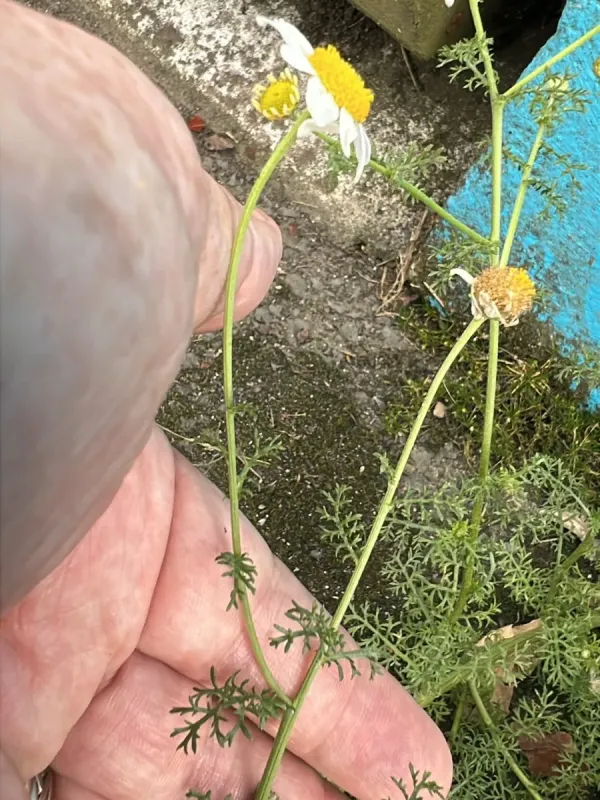
The plant grows to a height of 20–50 cm with a branching, erect stem that is typically hairless or slightly pubescent. The leaves are alternate, finely divided into narrow, linear lobes, giving the plant a feathery appearance.
The flower heads are solitary, appearing at the tips of the stems. They feature white ray florets surrounding a yellow, dome-shaped center filled with yellow disk florets, which are highly fertile.
The root system is a taproot that is moderately branched, allowing the plant to thrive in various soil types. The small, rough-surfaced seeds are known for their longevity in the soil seed bank.
Stinking chamomile reproduces entirely by seed. A single, well-developed plant can produce tens of thousands of seeds in a single growing season, making it a prolific colonizer of disturbed land.
Where it grows
This species is widely distributed in temperate regions. It is commonly found in agricultural fields, pastures, roadsides, farmyards, and other disturbed areas that have high nutrient levels.
In agriculture, it is a significant weed in cereal crops, oilseed rape, and vegetable fields. It thrives particularly well in compacted or slightly damp soils where competition from other vegetation is lower.
Stinking chamomile often colonizes headlands and margins, acting as a constant source of re-infestation for adjacent crop fields. It is frequently seen in fields with poor drainage or over-worked soil.
The weed is highly opportunistic and can quickly dominate fallow fields if left undisturbed. It is often one of the first species to establish itself on recently tilled or bare soil.
Because it is well-adapted to different environments, it can spread rapidly across vast farm landscapes via equipment, contaminated seed, or natural vectors like wind and water.
Harm it causes
The primary damage caused by stinking chamomile is crop competition. It aggressively absorbs nutrients, moisture, and sunlight, often reducing the yields of wheat, barley, and other row crops significantly.
It contains compounds that can cause contact dermatitis in humans and livestock. When livestock consume the plant, it can lead to health issues and taint the flavor of milk and meat products due to its volatile oils.
The presence of chamomile seeds in harvested grain is problematic for grain handling facilities. It often requires extra cleaning processes and can lead to downgrading the quality of the commercial grain batch.
Stinking chamomile can also act as an alternate host for several plant viruses and pathogens, facilitating the spread of diseases that affect high-value agricultural commodities.
Its allelopathic effects can suppress the germination and early root development of sensitive crops, creating patches of poor growth in otherwise healthy fields.
How to control
Cultural control begins with crop rotation. By planting competitive crops, such as dense stands of grasses or legumes, the plant is deprived of the light it needs for survival during the seedling stage.
Mechanical tillage and timely row cultivation in summer crops are effective in destroying young plants before they reach the flowering stage. Frequent harrowing can also uproot seedlings effectively.
Chemical control is often necessary and highly effective. Herbicides from the synthetic auxin group (such as 2,4-D or MCPA) or ALS-inhibitors are commonly used during the early vegetative stage of the weed.
Hygiene practices are essential to prevent further spread. Cleaning farm machinery between fields and ensuring that seed stocks are certified and free from weed contaminants are key preventive steps.
Mowing or removing the plant from fence lines and field borders before it sets seed is crucial to stop the annual replenishment of the seed bank, which is the long-term solution for management.
Content graph
Connections · Stinking chamomile
Most often together:
Marketplace
Products · 6


Trimer
Цзянсуський завод отрутохімікатів «Жуй Бан», Джітан , Китай.
Herbicides
0
0
·
1.6K
1 offer
85.35 €per pack
Buy


Gerber
Superus Co., Ltd., Китай, Yangzhou Pioneer Chemical Co., Ltd., Китай
Herbicides
0
0
·
1.9K
No offers
—
Details

Biology
Taxonomy
- Latin name
- Anthemis cotula
- Family
- Сложноцветные (астровые)
- EPPO code
- ANTCO