
Broomrape Is No Longer Just a Southern Problem: How the Parasite Is Changing the Rules of Sunflower Cultivation
Sunflower broomrape has long ceased to be a local problem limited to certain regions. While it was once considered a typical threat mainly for the southern regions, today farmers are increasingly recording infestations in central and even western parts of…
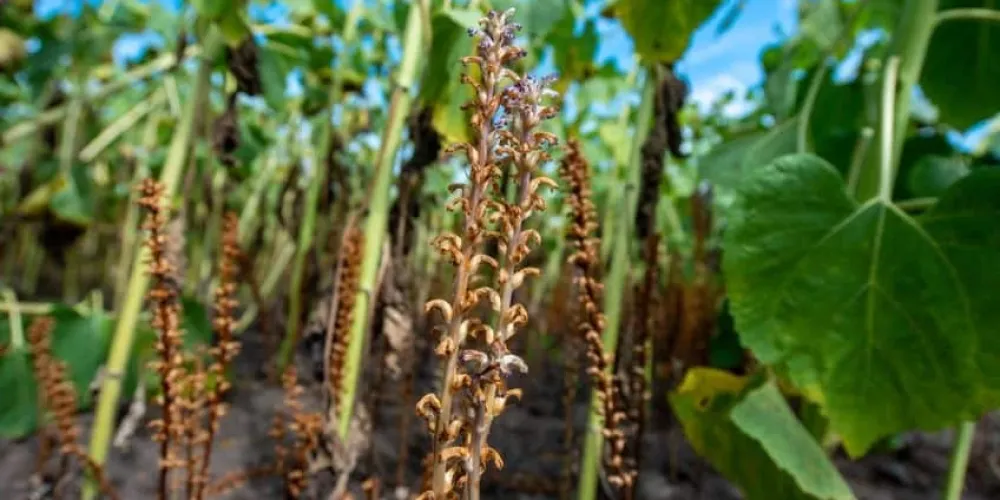
Sunflower broomrape has long ceased to be a local problem limited to certain regions. While it was once considered a typical threat for the southern oblasts, today farmers are increasingly recording infestations in central and even western regions of Ukraine.
The Agro Pioneer company notes that in recent years the situation has worsened significantly. Due to intensive sunflower cultivation, shortened crop rotation, and changing climate conditions, the parasite is spreading rapidly and adapting to new environments.
Why broomrape is more dangerous than it seems
Unlike most weeds, broomrape does not compete with the crop for light or space. It is a parasite that feeds directly from the sunflower root system, exhausting the plant even before visible symptoms appear.
This is exactly where its main danger lies. By the time broomrape becomes noticeable in the field, part of the potential yield has already been lost.
Plant suppression is often mistakenly associated with drought or nutrient deficiency, although the real cause may be the parasite itself.
Why the problem is getting worse
One of the key reasons for the spread of broomrape is нарушення crop rotation. Frequent return of sunflower to the same field leads to the accumulation of parasite seeds in the soil.
An additional factor is its ability to evolve quickly. Every year, new and more aggressive races appear that can overcome the genetic resistance of hybrids.
Why it is so difficult to control
Broomrape seeds are extremely small, almost like dust, and can remain in the soil for years. They germinate only when they sense the roots of a host plant, which makes controlling the parasite by traditional methods much more difficult.
Which approach works today
Effective control of sunflower broomrape is possible only through an integrated approach. Using just one tool, even the most advanced one, does not provide stable results, especially under conditions of a high infection background.
In practice, the most effective strategy is a combination of several solutions.
1. The first level of protection is the correct choice of hybrid. Modern hybrids have genetic resistance to different broomrape races (7+), which helps reduce the risk of infestation from the very start. However, it is important to consider that the parasite adapts quickly, so using the same hybrid for several consecutive years may reduce the effectiveness of this protection.
2. The second important element is herbicide control technologies. In farms with a high level of infestation, systems based on imidazolinones work effectively, particularly the Clearfield and Clearfield Plus technologies. Their special feature is that the active ingredient enters the plant and moves toward the root system.
As a result, so-called internal protection is created: when broomrape tries to attach itself to the sunflower root, it immediately receives a dose of herbicide and dies at the early stages of development. In addition, part of the product remains in the upper soil layer, forming an external barrier for parasite seedlings.
This approach makes it possible to control broomrape before it emerges above the soil surface, which is critically important because the main damage to the crop occurs underground.
3. The third component is crop rotation. A break in sunflower cultivation on the same field for at least 6 to 8 years makes it possible to significantly reduce the stock of parasite seeds in the soil. In addition, so-called trap crops such as corn, soybean, flax, millet, and Sudan grass can be an effective tool. They stimulate broomrape germination but do not allow it to attach and develop.
Also, control over the transfer of parasite seeds is no less important. Even a small amount of soil on machinery or uncleaned equipment after working in infested fields can become a source of broomrape spread to new areas.
As noted by Agro Pioneer, in zones with a high level of infestation, the most effective solution is precisely a combined approach, where genetic resistance is combined with herbicide solutions and proper agronomic practices. This makes it possible to control the parasite at early stages of development and prevent its accumulation in the soil.
What farmers need to consider
Today, broomrape is already a systemic challenge for sunflower cultivation in Ukraine. Ignoring the problem or continuing to work according to привычными schemes can lead to significant yield losses.
The main task of the farmer is to prevent the accumulation of parasite seeds in the soil. Even one missed plant is capable of producing hundreds of thousands of seeds and creating a problem for several seasons ahead.
Editorial team agronom.info
Materials are prepared by the portal's agronomists and editors. We use only trusted sources: Ukrainian agricultural universities, variety registries, open scientific publications.
Related articles

Not yet comments. Be the first!
Comments · 0