
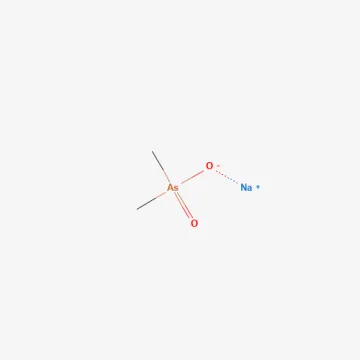
Sodium dimethylarsinate
Description
Mode of action
Sodium dimethylarsinate, commonly referred to as sodium cacodylate, functions as a systemic herbicide belonging to the class of organic arsenic compounds.
The herbicide works by interfering with the metabolic pathways of plants, specifically targeting enzymatic reactions that are vital for protein synthesis and tissue maintenance.
Upon application, the active ingredient is absorbed through leaves and stems, and is translocated throughout the plant's vascular system, causing rapid wilting and necrosis.
Its efficacy is largely dependent on environmental conditions, with the highest impact achieved during periods of active plant growth, high humidity, and sufficient sunlight.
In the soil environment, the compound undergoes microbial degradation over time, breaking down into simpler, though still potentially toxic, inorganic arsenic species.
What it targets
This group of chemicals is primarily utilized as a non-selective herbicide for managing a wide range of annual and perennial grasses and broadleaf weeds.
It is frequently applied on non-cropland areas, such as rights-of-way, industrial sites, and utility corridors, to maintain clear access and prevent unwanted vegetation encroachment.
The substance is also employed as a desiccant, facilitating the drying of plant tissues prior to the harvesting of certain technical crops to improve operational efficiency.
In forestry applications, it may be used for thinning or controlling undesirable woody species, often via trunk injection methods to target specific individuals.
Its ability to suppress tough, deep-rooted weed species makes it a specialized tool for vegetation management in challenging non-agricultural environments.
Rates and timing
Application rates for sodium dimethylarsinate must be strictly calibrated based on the target species density and the intended goal of the treatment, such as total kill or desiccation.
Optimal timing is crucial for success; treatments should be performed when weeds are in their most vigorous growth phase to maximize uptake and systemic translocation.
When used for industrial site clearance, uniform coverage is essential, requiring precise equipment calibration to ensure that the chemical reaches all parts of the target foliage.
For forestry applications, precise dosage per stem is required, often determined by the specific tree species and its physiological state at the time of intervention.
Operators must adhere to regional guidelines regarding the frequency of applications to prevent the accumulation of arsenic residues within the local ecosystem.
Restrictions
The use of sodium dimethylarsinate is heavily restricted globally due to its significant toxicity to mammals and its potential for long-term persistence in the environment.
It is strictly prohibited for use on food or feed crops to prevent the contamination of the human and animal food chain with arsenic-based residues.
Workers must wear comprehensive personal protective equipment (PPE), including chemical-resistant suits and respiratory protection, to avoid any exposure to the concentrated substance.
Great care must be taken to prevent drift, as the herbicide can cause severe damage to non-target vegetation and pose a critical risk to aquatic life if it enters waterways.
All disposal of container remnants and unused chemical solutions must strictly follow established protocols for hazardous waste to avoid groundwater contamination.
Status in the European Union
Not approved in the EU
- CAS number
- 124-65-2
- Category (EU)
- RO - Rodenticide
EU status is for reference only and does not replace national registration in your country.