

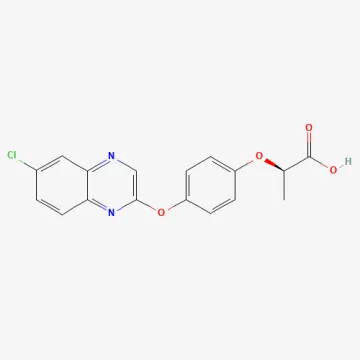
Description
Mode of action
Quizalofop-P-ethyl is a selective, systemic herbicide belonging to the aryloxyphenoxypropionate chemical family. It is widely used in agriculture as a potent graminicide to control grass weeds in broad-leaved crops.
The active ingredient is rapidly absorbed through the leaves and translocated throughout the plant via the phloem and xylem to the meristematic tissues and root systems. This systemic property is essential for the effective eradication of perennial grasses.
The biochemical mode of action involves the inhibition of the enzyme acetyl-CoA carboxylase (ACCase), which is critical for fatty acid biosynthesis. By disrupting this process, the herbicide halts the formation of cell membranes and lipids.
Following application, growth stops almost immediately. The first symptoms, including chlorosis and necrosis of the growing points, become visible within a few days, leading to the total death of the weed within 2–3 weeks.
The selectivity of Quizalofop-P-ethyl is attributed to the rapid metabolic degradation of the molecule in broad-leaved plants into non-toxic metabolites, whereas grass species lack this detoxification mechanism.
What it targets
This substance is highly effective against a wide array of annual and perennial grass weeds. It is specifically designed to target graminaceous plants that compete with row crops for water, nutrients, and sunlight.
Key weed species controlled include couch grass (Elymus repens), barnyard grass (Echinochloa crus-galli), foxtail species (Setaria spp.), wild oat (Avena fatua), and volunteer cereals. It remains highly effective even under varying environmental conditions.
The herbicide is most effective when applied to weeds that are in their active growth phase. Managing weeds at the right stage of development ensures better uptake and faster results throughout the field.
It is important to note that Quizalofop-P-ethyl has no effect on broad-leaved weeds or sedges. Consequently, it is often utilized in integrated weed management programs alongside other herbicides to ensure comprehensive field coverage.
By controlling grass infestations early in the crop cycle, farmers can significantly protect yield potential and simplify harvest procedures by reducing the biomass of weeds within the field.
Rates and timing
Application rates for Quizalofop-P-ethyl depend on the specific weed species present and the level of infestation. Generally, rates ranging from 0.4 to 1.2 liters per hectare are recommended for effective control.
For annual grasses, the optimal timing is at the 2 to 4-leaf stage. Perennial grasses should be treated when they are between 10 and 15 centimeters tall to ensure enough surface area for maximum herbicide absorption.
The product performs best under mild to warm temperatures, typically between +15°C and +25°C. The plants must be in an actively growing state to facilitate the translocation of the herbicide to the root systems.
Proper spray coverage is vital; therefore, a water volume of 200–300 liters per hectare is standard. The use of appropriate adjuvants can further improve the adhesion and penetration of the herbicide into the plant cuticle.
When mixing with other pesticides, users must verify compatibility. Mixing with broad-leaved herbicides may result in antagonism, so it is often better to apply these products sequentially unless compatibility is proven.
Restrictions
A critical restriction is the strict prohibition of using this herbicide on cereal crops or grasses such as wheat, barley, or corn, as it will cause severe injury or complete crop destruction.
Avoid application during periods of severe drought, extreme cold, or heat stress. When weeds are under stress, their metabolism slows down, significantly reducing the systemic effectiveness of the herbicide.
Care must be taken to prevent drift onto neighboring cereal fields. Operators should use low-drift nozzles and avoid application during high wind speeds, which could lead to unintended damage to adjacent crops.
Always adhere to the pre-harvest intervals specified on the product label to ensure that the final crop is safe for consumption and meets maximum residue limit (MRL) standards.
Personnel handling the chemical must use appropriate personal protective equipment (PPE). After application, restricted entry intervals (REI) must be followed to prevent human exposure to the treated area.
Regulatory
Status in the European Union
Approved in the EU
- CAS number
- 100646-51-3
- Category (EU)
- HB - Herbicide
- Approved from
- 01.12.2009
- Approval until
- 28.02.2027
- ADI
- 0.009 mg/kg bw/day
- ARfD
- Not appl.
- AOEL
- 0.01 mg/kg bw/day
EU legislation
EU status is for reference only and does not replace national registration in your country.
Content graph
Connections · Quizalofop-P-ethyl
Most often together:
Marketplace
Products · 4

Bagira Super
«Юнісіті Ентерпрайсіс Л.П.», Единбург, Великобританія
Herbicides
0
0
·
56
No offers
—
Details

Herbicide "KVI NT STAR" a.s.
«Нанджин Ессенс Файн-Кемікал Ко. Лтд» (Китай)
Herbicides
0
0
·
46
No offers
—
Details
