

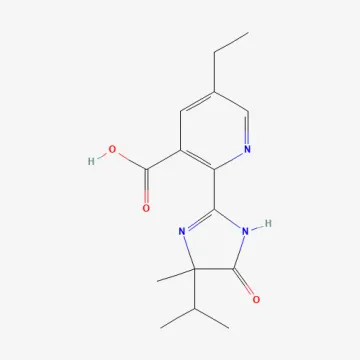
Description
Mode of action
Imazethapyr belongs to the imidazolinone chemical class. It functions as a systemic herbicide with both foliar and soil-applied activity.
The primary mechanism of action involves the inhibition of the acetolactate synthase (ALS) enzyme, which is essential for the biosynthesis of branched-chain amino acids.
Once the enzymatic activity is blocked, the plant stops producing proteins necessary for growth, leading to a swift cessation of weed development.
The herbicide is absorbed by weeds through leaves and roots. Due to its systemic nature, it moves throughout the vascular system, accumulating in meristematic tissues.
Visible symptoms appear as yellowing of the growth points and stunted development. The total destruction of susceptible weeds typically occurs within a few weeks.
What it targets
Imazethapyr is primarily used to control a broad spectrum of annual and perennial broadleaf weeds, as well as several grass species in legume crops.
It effectively targets problematic weeds such as ragweed, pigweed, mustard, nightshade, and various Chenopodium species commonly found in agricultural fields.
The herbicide is particularly valued for its residual soil activity, which helps suppress subsequent germination flushes of weeds over a prolonged period.
For optimal results, weeds should be in their early growth stages, typically between the cotyledon and four-leaf stage, for maximum sensitivity.
The range of weeds controlled makes it a vital tool in soybean and pea integrated pest management programs globally.
Rates and timing
Application rates generally range from 0.4 to 1.0 liters per hectare depending on the specific formulation, soil characteristics, and local weed pressure.
In soybean crops, application is most effective when the crop is in the 1 to 3 trifoliate leaf stage, ensuring the weeds are properly covered.
Soil moisture plays a crucial role in the herbicide's effectiveness, as it promotes root uptake and enhances the residual control of emerging weeds.
Proper spray equipment calibration is essential to ensure uniform coverage and avoid excessive concentrations that could stress the crop.
Farmers are advised to follow manufacturer guidelines regarding spray volumes and additives to optimize the chemical's penetration into plant tissues.
Restrictions
The most significant limitation associated with Imazethapyr is its long-lasting persistence in the soil, which necessitates careful crop rotation planning.
Sensitive crops, such as winter wheat or sugar beets, may suffer damage if planted too soon after an application, often requiring a waiting period of 12–18 months.
Application should be avoided on soils with low organic matter or extreme pH levels, as these factors can influence the herbicide's breakdown rate and crop safety.
Resistance management is critical; rotating herbicides with different modes of action is recommended to prevent the buildup of ALS-resistant weed populations.
Care must be taken to prevent spray drift onto non-target areas, as neighboring fields may contain crops highly sensitive to imidazolinone herbicides.
Content graph
Connections · Imazethapyr
Most often together:
Marketplace
Products · 39


Picador
ТОВ «Фабрика агрохімікатів», Черкаси, Україна
Herbicides
0
0
·
1.5K
8 offers
5.5 €per 1 l
Buy


Pari
Superus Co., Ltd., Китай, Yangzhou Pioneer Chemical Co., Ltd., Китай
Herbicides
0
0
·
810
1 offer
6.95 €per 1 l
Buy


Herbicide PICA-DOR, V.R.K., (imazethapyr 100 g/l)
«Нанджин Ессенс Файн-Кемікал Ко. Лтд» (Китай)
Herbicides
0
0
·
55
1 offer
10.42 €per 1 l
Buy

Picket SL
Nanjing No.1 Pesticide Factory of Red Sun Group Co., Ltd.
Herbicides
0
0
·
53
1 offer
85.75 €per pack
Buy


Emerald W.R.K., (Imazethapyr 100 g/l)
Sharda Worldwide Exports Pvt Ltd, Sharda World
Herbicides
0
0
·
47
4 offers
9.01 €per 1 l
Buy

Serp, w.r.k., (imazethapyr, 100 g/l)
Peters & Burg Kft.
Herbicides
0
0
·
40
1 offer
8.87 €per 1 l
Buy


Magister, w.r.k.
Санрайз Кемікалз Ко. Лтд., Шанхай, Китай
Herbicides
0
0
·
29
4 offers
76.06 €per 1 l
Buy




Fabian, WDG Herbicide
ЗАТ Фірма Август, Росія.,селище Вурнари,
Herbicides
0
0
·
64
No offers
—
Details


Pari V.R.K., (Imazethapyr 100 g/l)
Ф.Суперус Ко ., Лтд., Гонг-Конг, Шанхай, Китай.
Herbicides
0
0
·
51
No offers
—
Details


Stobob, SL (imazethapyr, 5 g/l + bentazone, 400 g/l)
Jiang'an Agrin Company Ltd.
Herbicides
0
0
·
30
No offers
—
Details


Stobob, RK (imazethapyr, 50 g/l + bentazone, 400 g/l)
Jiang'an Agrin Company Ltd.
Herbicides
0
0
·
26
No offers
—
Details